

COP30 got the ball rolling to fund forest protection. Here’s how Woodwell is maintaining momentum.
Senior Policy Advisor Frances Seymour recaps how last year’s climate conference played out for forest finance


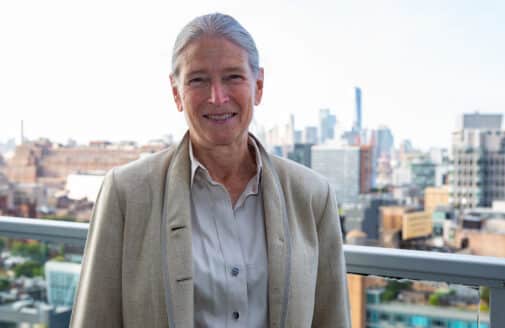
Frances Seymour speaks on a panel about tropical forests.
photo by Hilton Silva/ TED Countdown
When I started at Woodwell this time last year, preparations for November’s COP30 in Brazil were in full swing. The prospect of international climate negotiations hosted in the Amazonian city of Belém provided a rare opportunity to focus attention on the under-appreciated roles of tropical forests in meeting climate mitigation and adaptation objectives. Woodwell’s presence at COP30—making presentations, speaking on panels, and meeting with national delegations—helped to deliver on that promise. Now our challenge is to maintain momentum on the many forest-related initiatives featured there.
My own focus at COP30 was promoting ways to mobilize new sources of funding to meet the needs for tropical forest protection, estimated by the United Nations Environment Programme to total $68 billion annually. In the preceding months, I supported the Forest & Climate Leaders Partnership (FCLP)—a coalition of countries working to halt and reverse deforestation by 2030—to construct a “roadmap” on forest finance. The roadmap, launched in September during New York Climate Week, consists of six solutions ranging from carbon markets to sovereign debt management. The solutions are interlocking puzzle pieces that together could go a long way towards closing the finance gap.
One puzzle piece is the Tropical Forest Forever Facility (TFFF), an innovative forest finance mechanism (described in the Fall 2025 edition of this magazine) launched by the Brazilian COP30 Presidency and endorsed by 66 countries. The Facility will make annual payments to tropical forest countries per hectare of forest conserved, providing an important complement to other sources of forest finance. Funding for the payments will be generated by the Tropical Forest Investment Fund (TFIF), which relies on long-term loans and guarantees from sponsor countries to leverage commercial debt finance, which will in turn be invested in higher risk, higher return bonds. An impressive $6.7 billion in pledges were garnered toward the Fund by the end of the COP.
The ultimate target for sponsor capital is $25 billion, no easy task in the current geopolitical environment.
Having been a champion of the TFFF, contributing to its design during my service in the office of the Special Presidential Envoy for Climate in the Biden Administration, I was pleased with this outcome. At the same time, I am also well aware of the hurdles still ahead. Most immediately, the pressure is on to raise additional sponsor capital quickly: the Norwegian contribution of $3 billion to the TFIF is contingent on reaching at least $10 billion by the end of 2026. The ultimate target for sponsor capital is $25 billion, no easy task in the current geopolitical environment.
There’s also a lot of work to do on the spending side of the TFFF. An initial TFFF secretariat hosted at the World Bank will need to finalize the technical criteria for country eligibility and payments. Many tropical forest countries will need assistance in meeting specifications for satellite-based forest monitoring systems and financial management systems to ensure that at least 20% of the payments are channeled to frontline Indigenous peoples and local communities. These groups are often the most effective forest stewards. Woodwell scientists are engaging directly with the TFFF secretariat and key stakeholders in the design process, as well as providing analysis to build investor confidence that payments will result in their intended impacts.
Fortunately, those countries will be able to build on the extensive capacity and institutional infrastructure that has been developed through jurisdictional REDD+ (JREDD+) programs over the last two decades. Such programs serve as the basis for forest carbon crediting at the scale of entire countries or large subnational states, provinces, or Indigenous territories. Crediting over such large areas reduces the risks to social and environmental integrity that have troubled project-scale crediting.
At COP30, I had the pleasure of facilitating the first meeting of a newly launched Scaling JREDD+ Coalition incubated by the FCLP. The Coalition brings together governments, non-governmental organizations, and private sector actors to collaborate to address barriers to increasing both supply and demand for JREDD+ credits. Participants in the meeting identified nine issue areas needing collaborative action. They volunteered to work on task forces to address obstacles on both the supply and demand sides of forest carbon markets, ranging from how to nest projects into jurisdictional-scale programs to how to communicate more effectively to prospective buyers. Woodwell is well-placed to contribute to this work, and for me, it aligns with my service on the board of a JREDD+ certification body.
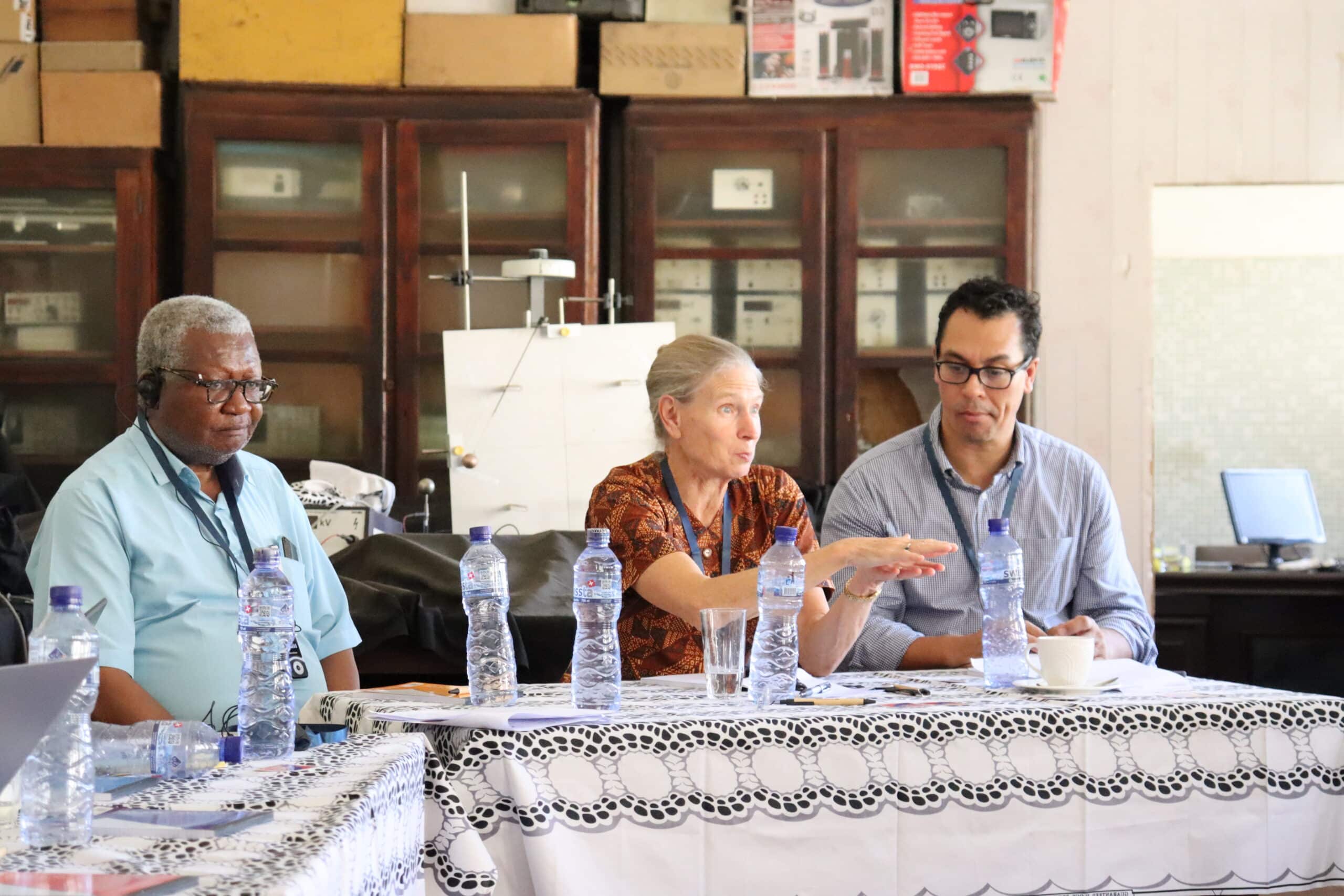
Frances Seymour participates in a forest carbon workshop in the DRC.
photo by Abby Fennelly
One of the most promising approaches for aligning finance with forest conservation goals is to raise awareness of the risks posed by deforestation to agricultural productivity and national economies. A key puzzle piece in the FCLP forest finance roadmap is to redirect private investment in traditional agricultural supply chains toward production systems that conserve forest resilience and the climate-stabilizing services forests provide.
In support of this approach, Woodwell scientists are leading contributors to the growing body of evidence showing how forest loss compounds the destabilizing effects of global warming by increasing local temperature extremes and disrupting rainfall patterns. We featured these findings at several events in Belém, including closing the TED Countdown House program with an entertaining game-show format, in which teams in the audience competed to guess the answers to questions about the implications of these findings for agriculture, water, and health.
Over the course of 2026, Woodwell staff—in coordination with our colleagues at our Brazil-based partner organization, the Amazon Environmental Research Institute (IPAM)—will be engaging with the Government of Brazil as it develops another forest-related “roadmap”. Promised at the close of COP30, this roadmap will be more broadly focused on achieving the globally agreed-upon goal of halting and reversing forest loss and degradation by 2030. We’ll be working to ensure that the roadmap’s recommendations are informed by science. We’ll also be advocating for a process inclusive of the diverse countries, companies, and communities whose actions will determine whether or not the map leads to its desired destination.
REDD+: Stands for Reducing Emissions from Deforestation and forest Degradation (plus conservation, sustainable forest management, and enhancement of forest carbon stocks). REDD+ is a UN framework for providing financial incentives to developing countries by rewarding forest-based emissions reductions and removals.
JREDD+: Jurisdictional REDD+ refers specifically to REDD+ programs in which forest carbon emissions and removals are measured at the jurisdictional scale of entire countries or large subnational areas such as states or provinces rather than at the level of projects.
TFFF: The Tropical Forest Forever Facility is an innovative financial mechanism that will distribute funds to tropical forest countries to reward effective conservation of standing forests. The Facility was launched by the government of Brazil in 2025 and is hosted by the World Bank.
TFIF: The Tropical Forest Investment Fund seeks to raise $25 billion in sponsor capital from sovereign and philanthropic investors, which will, in turn, leverage commercial finance from investors seeing long-term returns. The Fund will be invested to generate returns above its cost of borrowing, which will serve as the basis for annual payments managed by the TFFF.
Forest & Climate Leaders Partnership: The FCLP is a voluntary coalition of countries formed to accelerate implementation of the global goal of halting and reversing forest loss and degradation by 2030. Currently co-chaired by the United Kingdom and Guyana, the FCLP has representation from the Global North and the Global South, and its 37 members (plus the European Union) cooperate in six action areas, including scaling forest carbon markets.
Roadmaps: Roadmaps are plans created by international actors that guide progress towards a goal. In 2025, FCLP members collaborated to produce a Forest Finance Roadmap as an input to COP30 in Belém, Brazil. At the close of COP30, the government of Brazil announced that it would lead preparation of two Roadmaps over the course of 2026: one to guide the transition away from fossil fuels, and one to halt and reverse deforestation by 2030.
Carbon Markets: Carbon markets facilitate transactions between willing buyers and sellers of carbon credits. Such credits represent units of carbon dioxide removed from or prevented from being emitted to the atmosphere. Carbon markets can be voluntary or compliance-based, domestic or international. Different markets have different rules regarding the eligibility of and/or standards for forest-based credits, and all of these markets are evolving rapidly.


Latest in Tropics
- In The News
Twelve women carrying the flame for climate action despite the headwinds
- In The News
What the COP30 climate summit in the Amazon delivered for forests and Indigenous people
- In The News