

The only thing crazier than talking about solar radiation management is not talking about it


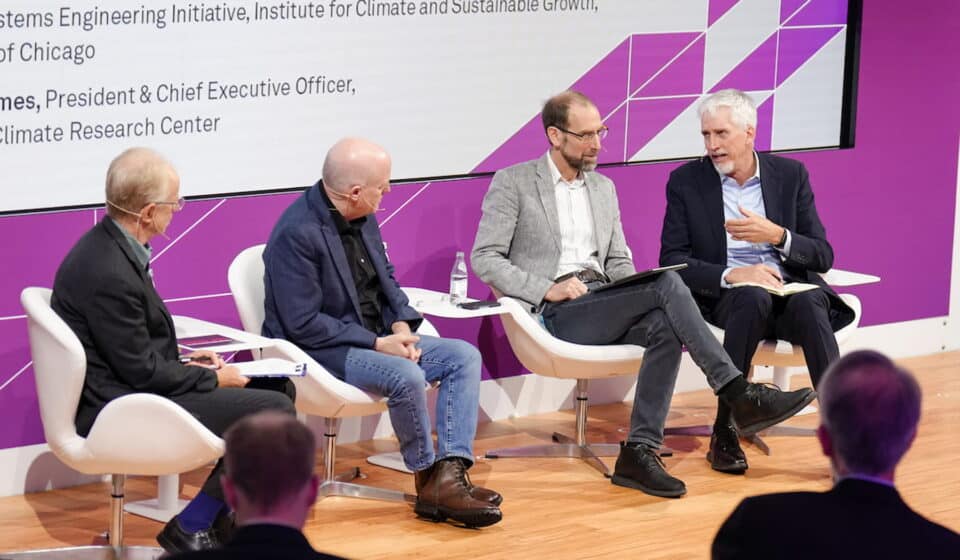
CERAWeek panel session on “Geoengineering the Climate” (left to right: Paul Markwell, S&P Global, moderator; Dan Schrag, Harvard University; David Keith, University of Chicago; Max Holmes, Woodwell).
photo courtesy of CERAWeek
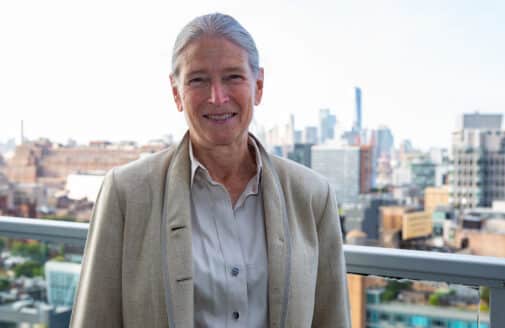
A message from President & CEO Dr. Max Holmes
Last week, I sat on two panels at CERAWeek in Houston—the world’s premier energy conference, attended by thousands of energy executives but also several climate scientists. One panel focused on nature-based climate solutions: the management and conservation of forests, soils, and other natural systems to harness their extraordinary capacity to draw carbon out of the atmosphere and store it. That is Woodwell’s home territory, and a topic I can discuss with the confidence of decades of institutional science behind me.
The second panel was on a topic many serious climate scientists have considered almost too hot to handle: that we may need to think carefully about intentionally reflecting sunlight away from Earth to slow global warming.
Woodwell has never shied away from science that challenges comfortable assumptions. If the status quo of climate action is insufficient to meet this moment—and it is—then expanding what we are willing to seriously examine is not a departure from our mission. It is an expression of it.
Let me start with what we know. The most important things society must do to address climate change remain exactly what they have always been: slash greenhouse gas emissions, draw carbon dioxide out of the atmosphere (most immediately through nature-based climate solutions), and prepare communities for the disruption already baked into the system. Woodwell’s science and policy work is built on that foundation, and nothing about our consideration of solar radiation management (SRM) changes it.
But we also have to be honest with ourselves about where we are. Despite decades of warnings from climate scientists, emissions continue to rise. We are on a trajectory to blow past the Paris Agreement’s temperature targets, likely in the next few years. Our own research underscores the danger: thawing Arctic permafrost, warming feedbacks from wetlands, and the potential dieback of Amazonian rainforest could accelerate emissions in ways that overwhelm even our best efforts. In that context, responsible science demands that we examine every possible option, including ones that make us deeply uncomfortable.
Solar radiation management refers to proposed approaches that would cool the Earth by reflecting a portion of incoming sunlight back into space. The most-discussed approach, stratospheric aerosol injection, would involve releasing reflective particles into the upper atmosphere via aircraft—mimicking the temporary cooling effect of large volcanic eruptions. Research suggests that if deployed, SRM could reduce surface temperatures and potentially limit the risk of crossing dangerous climate tipping points.
To be very clear, Woodwell is not advocating for deployment. SRM would do nothing to address the root causes of climate change, nor harmful consequences of rising carbon dioxide levels like ocean acidification. It carries real and poorly understood risks, including uncertain effects on rainfall patterns, crop yields, and ecosystems. And it raises profound questions of fairness and governance: who decides, and on whose behalf, to alter the global climate system? What happens if deployment begins and then stops abruptly, triggering “termination shock,” a rapid and dangerous rebound in warming?
These are exactly the questions that responsible research needs to answer. Woodwell believes that research on SRM must tackle priority scientific and ethical questions; must be international in scope, with meaningful participation from Global South nations and Indigenous communities; and must be well-governed, with robust standards. Our concerns include the Arctic, where the stakes of rapid warming are especially dire, consideration of SRM is increasing, and governance frameworks for SRM research are lacking.
There has been a temptation in the climate community to treat SRM, indeed, climate engineering more broadly, as a forbidden subject, to worry that even discussing it signals a surrender on mitigation, or opens the door to reckless deployment by actors unwilling to do the hard work of decarbonization. Those are legitimate concerns, and I share them. But the answer to the risks of SRM is not to ignore them. If deployment were to happen, whether carefully governed or not, we would be far worse off without the science to understand what was coming.
SRM is no longer a fringe conversation. It is being considered by the Intergovernmental Panel on Climate Change (IPCC), taken up in government research programs, in philanthropic investment decisions, and (whether we like it or not) in the ambitions of private actors operating with little to no oversight. Woodwell’s role is not to champion solar geoengineering. Rather, our mission is to provide science-based guardrails to ensure that as this conversation accelerates, it is shaped by rigorous science, ethical seriousness, and a commitment to effective and equitable governance.
This topic is not new to Woodwell. In 2023, we issued a policy brief on the need for research and governance of SRM and this past August, Woodwell awarded a grant through our Fund for Climate Solutions program to investigate whether Woodwell should further responsibly-governed SRM research. Led by Senior Science Policy Advisor Dr. Peter Frumhoff, a longtime thought leader on SRM governance, the project will bring together subject matter experts, NGOs, Arctic community thought leaders, and philanthropists to help inform future work in this space.
I had plenty of time to think about the challenges of SRM governance on my way home from CERAWeek. Flying out of Houston on Friday, I waited over four hours in a TSA screening line. Funding TSA would seem to be a relatively simple task, a core function of government.
Now consider governing a planetary intervention that would alter rainfall patterns, growing seasons, and temperatures across every nation on Earth, requiring sustained international cooperation among countries with profoundly different interests and vulnerabilities. The governance of SRM may, in fact, be a far greater challenge than the science of SRM.
Nature-based climate solutions will always remain central to Woodwell’s work. But we also recognize that they alone are not enough, and will not shy away from uncomfortable conversations about other approaches that may someday be necessary. Given the current reality of accelerating climate change impacts and relatively modest climate action, it may be that the only thing crazier than talking about solar radiation management is not talking about it.
Onward,