



Results summary
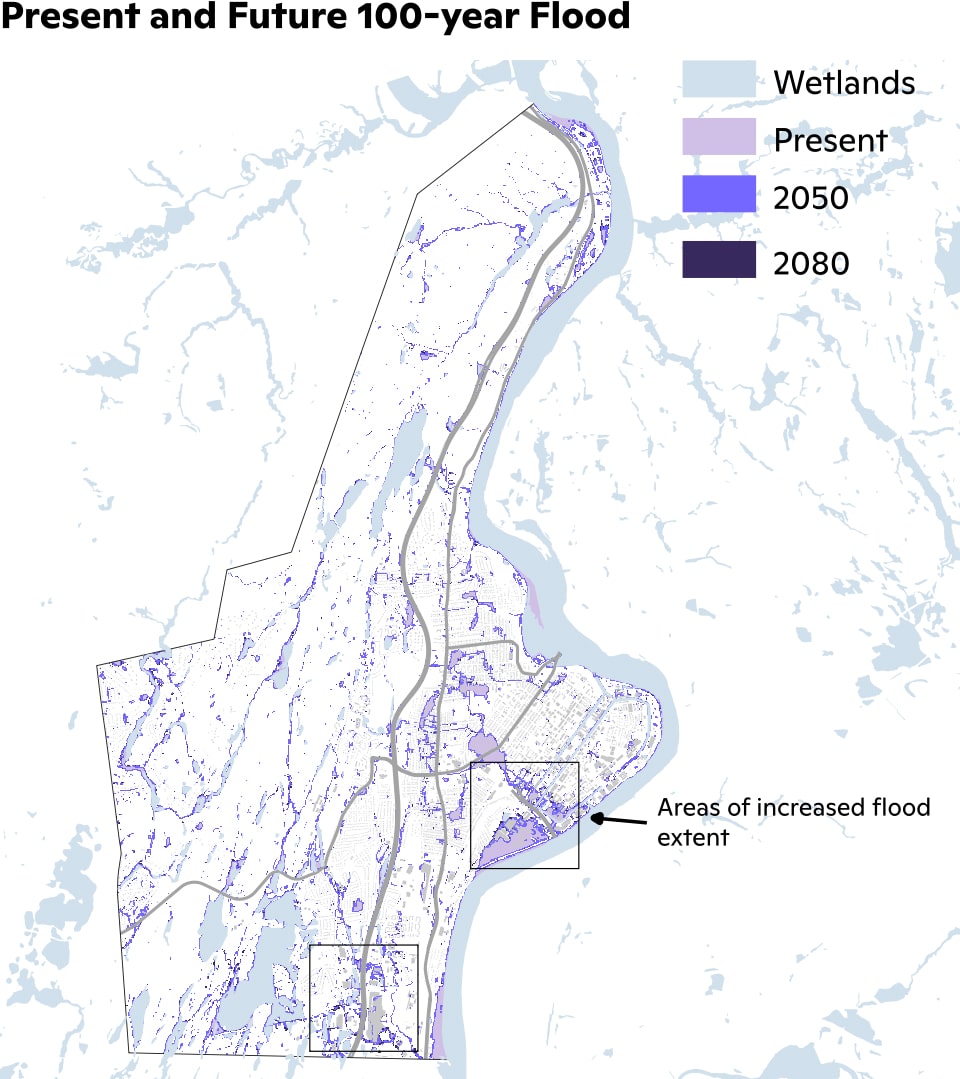
As a result of climate change, flood risk is projected to increase for Holyoke. The probability of the historical 100-year rainfall event, a useful indicator of flood risk, is expected to more than double by mid-century and be nearly five times as likely by the end of the century. Streamflow for the Connecticut River is also projected to rise throughout this century with an increase of 9% by 2050 and an additional 5% by 2080. Both increases in streamflow and heavier rainfall will translate into greater flood depths and extent for Holyoke. Here we present our findings on extreme precipitation and flooding to help Holyoke in its plans to create a more resilient future for all residents.
Extreme rainfall
The Fifth National Climate Assessment shows that the U.S. Northeast region has already seen a 60% increase in annual precipitation, the largest in the U.S., occurring from the heaviest 1% of events.1 Future warming is expected to continue this trend of intensification, meaning more frequent and severe rainfall events. Here we use localized future precipitation data from downscaled global climate models to calculate the change in probability of extreme rainfall events. A detailed explanation of the precipitation data processing can be found in the methodology section of this document. In Table 1, we show the changes in the return period of the present-day (2000–2020) 100-year rainfall event for mid-century (2040–2060) and late-century (2070–2090). By mid-century, the present-day 100-year event will occur with a return period of 1-in-40. By late-century, the present-day 100-year event will become a 1-in-21 year event.
According to the National Atlas 14 published by the National Oceanic and Atmospheric Administration (NOAA), the 100-year rainfall amount, based on present-day rainfall records, for Holyoke is 8.1 inches (206 mm).2 For reference, the present-day annual average rainfall for Holyoke is 42.9 inches (1090 mm).3 By mid-century, the 100-year amount will increase to 10 inches (254 mm) and by late-century this will further rise to 11.8 inches (300 mm; Table 1).