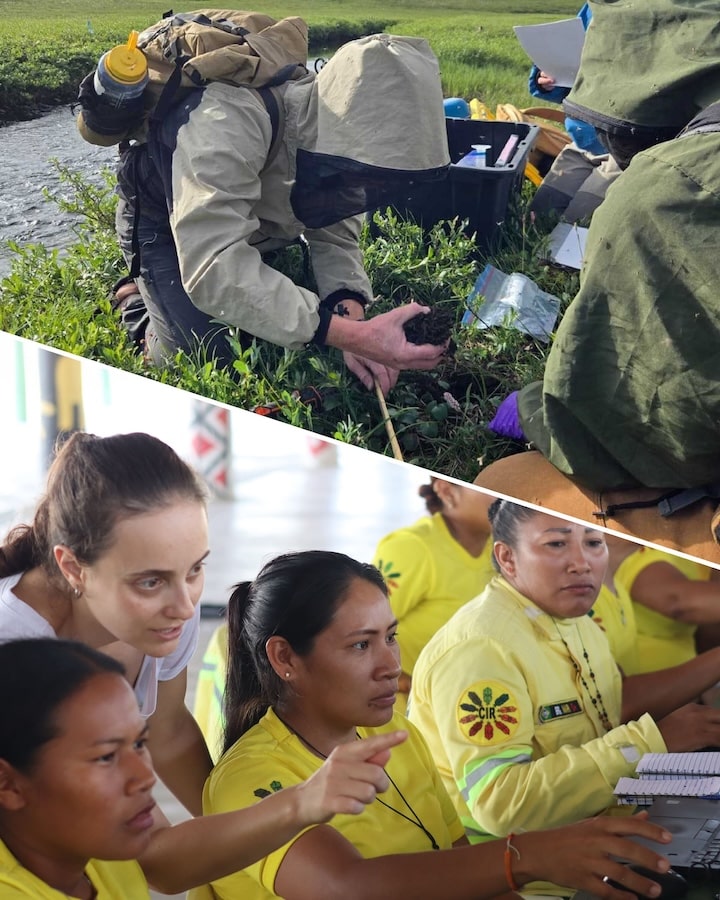


photo by Heidi Golden
The EVOME Institute Now Accepting Applications for Science Journalism Fellows for Summer 2026
Journalism Fellowships Offer Unique Opportunity to Experience Cutting-Edge Research
The National Science Foundation-supported Evolving Meta-Ecosystems Institute
(EVOME) will provide fellowships for six science journalists to participate in a two-week immersion in interdisciplinary evolutionary and global change biology being conducted at the University of Alaska’s Toolik Field Station in northern Alaska. Fellowships will cover transportation costs to and from the Toolik Field Station through Fairbanks, AK, plus room and board.
Ecosystems are complex communities of plants and animals that have evolved with each other and their shared environment over long periods of time. Understanding how these systems change over time is a grand challenge in biology—made even more urgent and policy-relevant by rapid changes in the Earth’s climate. This is particularly true for the Arctic, which is warming at least three times faster than the global average.
EVOME brings together experts from across biological disciplines to generate new insights at every scale of biology, with the goal of understanding whether species and ecosystems can evolve to match the pace of change, or whether they might fall apart or muddle along in a reduced state.
EVOME Journalism Fellowships offer a unique opportunity to get up close and personal with the scientists and experiments answering this critical question. The program will run June 14 to June 28, 2026. The first week will provide a hands-on exploration of key questions being asked at the intersection of evolutionary biology and Arctic ecology as part of the EVOME Institute. Then, fellows will team up with EVOME or Toolik-based research scientists, students, and postdocs, and work side-by-side with them in the field and laboratory. Fellows will have options to conduct interviews with other Toolik scientists, students, and staff, and will be expected to share their expertise in discussions and mentoring sessions with scientists, postdocs, graduate students, and undergraduate students at Toolik.
The EVOME journalism fellowship program will be directed by EVOME Institute Director Linda Deegan, Woodwell Climate Research Center Senior Scientist Christopher Neill, and Woodwell Climate Senior Fellow Heather Goldstone. For 14 years, Neill and Deegan led the Marine Biological Laboratory’s Environmental Hands-on Science Journalism Course that took journalists to Toolik Field Station (Arctic), Palmer Station (Antarctic), and four other NSF Long-term Ecological Research Sites. Goldstone is a science journalist and climate communicator with more than 15 years of experience.
Applications for the 2026 EVOME Journalism Fellowships are due Friday, March 27, 2026. Candidates are asked to submit:
- A short CV containing personal contact information, education, and professional experience,
- A 1000-word statement stating why this experience would benefit the candidate’s reporting and career,
- Four recent writing or audio samples, and
- Name and contact information for three personal references.
Submission is through Woodwell Climate’s application portal.
Applications from non-US citizens or green card holders are welcome. However, the EVOME institute will cover travel to and from Alaska only from points within the United States. Non-us citizens are responsible for securing appropriate U.S. visas for the fellowship period and travel to the United States.
What to Expect at Toolik
The Toolik Field Station, in the foothills of the Brooks Range about 150 miles south of the Arctic Ocean, is the US’s most important Arctic scientific research station. It is the site of the National Science Foundation’s Arctic Long Term Ecological Research (LTER) project and the Evolving Meta-ecosystems Institute (EVOME). The station can accommodate about 130 scientists at any one time. It’s a hub of activity for researchers and students in the U.S. Arctic each summer. Station residents live dorm style in simple but comfortable rooms. Meals are served in a communal dining hall overlooking beautiful Toolik Lake and high peaks of the Brooks Range. Scientists work in a variety of laboratory buildings and permanent tents on the Station’s grounds. Fellows will work in a specially-outfitted field laboratory with heat, electric power, and fast internet access.
The fellowship program will run from June 14 to June 30. Travel will be to and from Fairbanks by truck or van via the Dalton Highway that connects Fairbanks to the oil fields at Prudhoe Bay. The road is about half asphalt and half gravel. The trip is about 11 hours under good conditions but can be several hours longer if there are weather- or construction-related road closures. Large luggage will travel independently, so be prepared with a small bag with water, snacks, camera, or other essential items. We plan one day in Fairbanks before embarking to Toolik.
We will spend the first week visiting EVOME field sites, working with EVOME
scientists, and collecting data. EVOME science team members will then work with fellows will analyze and interpret the data. Fellows will work in pairs to create science presentations that they will then present in a mini science symposium open to the Toolik community.
The second week of the program will be less scripted. Fellows will have ample time to visit other field sites near Toolik and talk to the large number of scientists, postdocs, and students who will be at Toolik at that time working on the Arctic LTER and other projects.
You will experience Toolik bathed in 24 hours of sunlight. Daytime high temperatures range from the mid 40s to about 70 o F, but Arctic weather is fickle and can change on a dime. Freezing temperatures and snow are possible at any time. Fellows should plan to spend at least half of each work day in the field, whatever the weather.
Come prepared with a good raincoat, rain pants, and warm waterproof boots. Muck boots are good for short hikes through wet tundra. Newly-sealed and comfortable leather hiking boots are required for hiking in the mountains. Bring layers of fleece, long underwear, a warm hat and good gloves. Sneakers or rubber sandals is good for walking around the gravel pad around camp.
You will undoubtedly want to do some hiking. Bring a good day pack and a water bottle. You can bring your favorite hiking snacks, but the Toolik kitchen is more than amply supplied with great snack foods for the field. Bring binoculars if you are interested in birds and wildlife. Bring a camera. We enjoy posting pictures that document the research and the setting.
Toolik has a sauna and showers. Showers are limited to two two-minute showers per week to conserve water. The sauna is by the lake and operates with men’s, women’s, and co-ed hours evenings. Schedules are posted. Bring a towel, personal care items and any medications you think you might need. Trained first responders are on site at all times.