

photo by Dave Hollinger
In the field
In the third year of our research on the biophysical drivers of methane in a northern forest, our team:
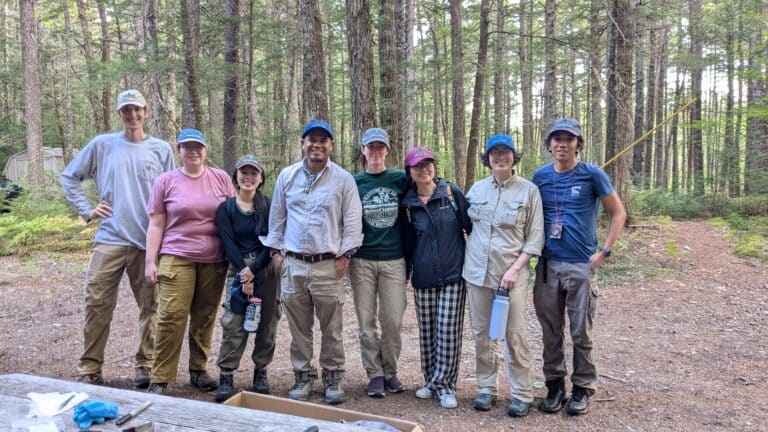
Conducted an intensive field campaign. From Sept 11-12, 2025 our group sampled 110 soil flux, with accompanying drivers such as temperature, moisture, pH, total soil carbon and nitrogen, soil bulk density and soil microbial populations.

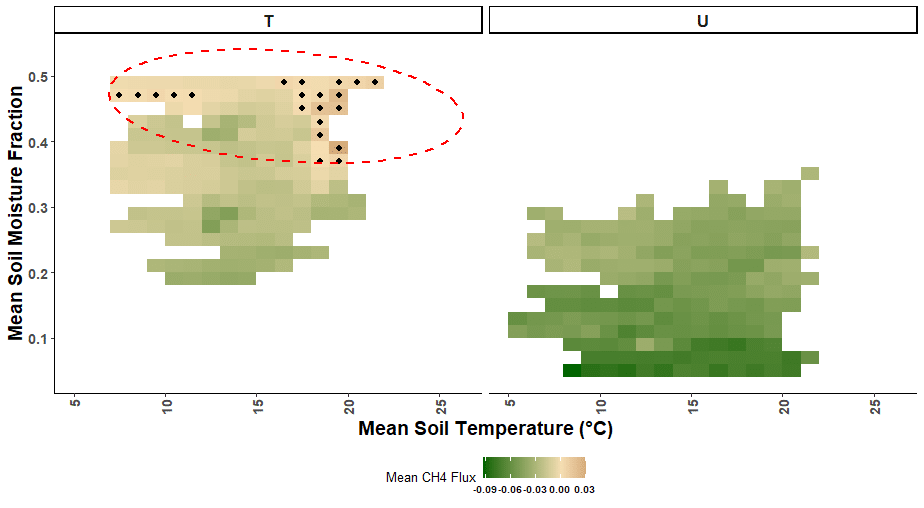
Analyzed data. Following two years of high temporal frequency automated methane soil flux samples (~20,000), including controlled water addition experiments within upland (U) and transitional (T) soils, we saw a distinct separation when soils are net methane sources or sinks at moisture levels around 38%, with little impact from changing soil temperature.
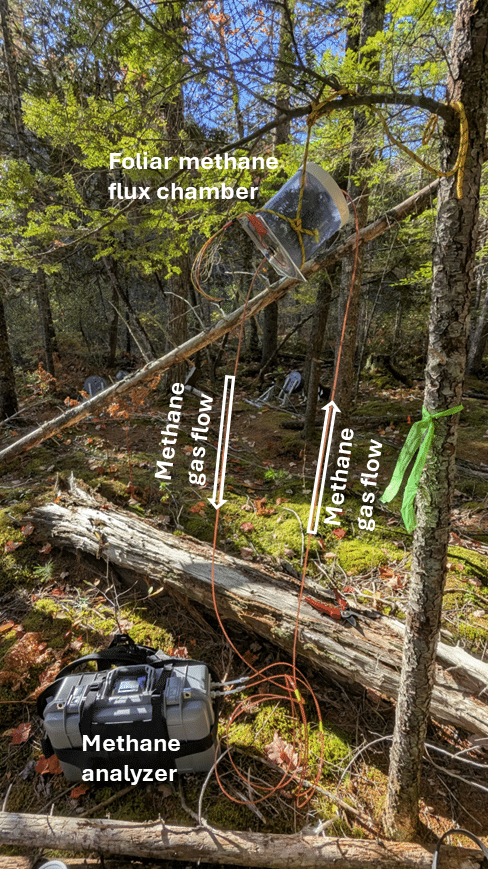
Created a new sampling method. We designed and deployed a novel tree stem and foliar flux sampling system to look at methane contributions from trees as part of a new project. Boreal Biosequester looks at tapping microbial populations on trees to optimize methane uptake.
At AGU
We presented our work at the fall 2025 American Geophysical Union meeting in New Orleans.
- Marlena Bartkus, Zoe Dietrich, Christian Hettwer, Jonathan Gewirtzman, Roel Ruzol, Shawn Fraver, Debjani Sihi, Jennifer Watts and Kathleen E Savage. Tree stem methane fluxes show distinct trends across the landscape of a northern conifer forest. Drivers of Soil Methane Sources and Sinks within a Northern Conifer Forest
- Kathleen E Savage, Zoe Dietrich, Marlena Bartkus, Christian Hettwer, Roel Ruzol, Shawn Fraver, Debjani Sihi, Hinsby Cadillo-Quiroz and Jennifer Watts. Drivers of Soil Methane Sources and Sinks within a Northern Conifer Forest. B23L-1911Understanding Soil CH₄ Sink-To-Source Transition in Sub-boreal Forest via Model-Data Fusion
- Rongyun Tang, Jennifer Watts, Kathleen E Savage, Xiaofeng Xu, Hinsby Cadillo-Quiroz, Shawn Fraver, Jaimie West, Hongyi Zhao and Debjani Sihi. Understanding Soil CH₄ Sink-To-Source Transition in Sub-boreal Forest via Model-Data Fusion.
Open House
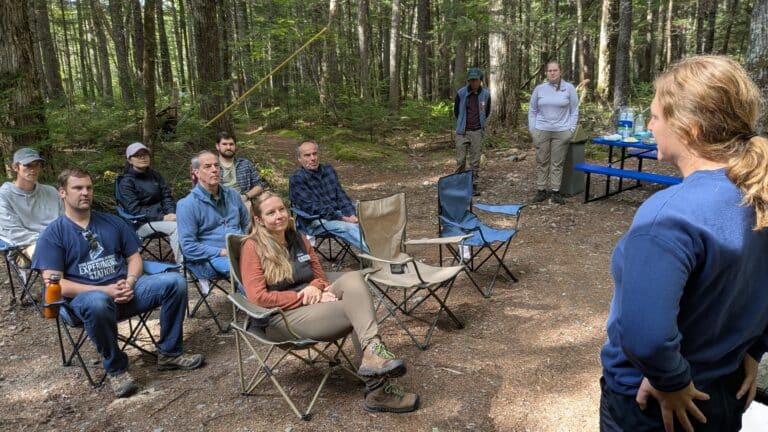
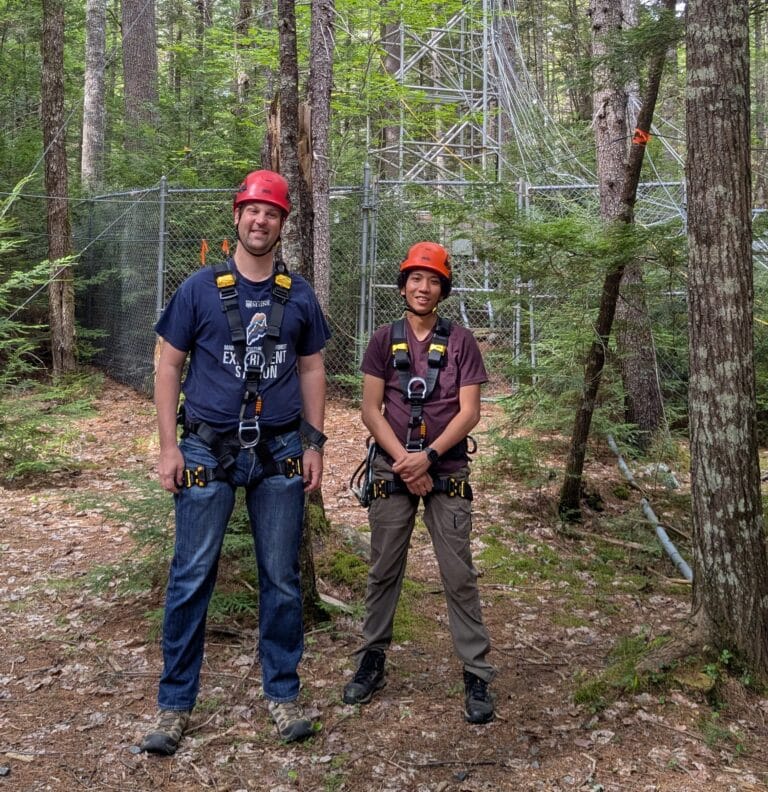
We held a public open house at the Howland Research Forest on Sept 13, 2025. Attendees walked through the mature forest, learned about the long-term research into its carbon dynamics, and were able to climate the eddy covariance tower, the second longest running tower in the US.
Overview of the tour
- The net carbon exchange tower. Established in 1996, it is one of the longest running net carbon exchange towers in the world.
- Measuring forest carbon. From soils to trees, understanding how carbon moves through a forest is important to forest health, and the role of microbes.
- NASA’S involvement. Established in 1989 the NASA plot contains highly detailed inventory of trees, including a 400-year-old yellow birch tree. This site was used as a training location for NASA’s early remote sensing capabilities.