

Submitted comment on guidance applicable to Forest Service programs


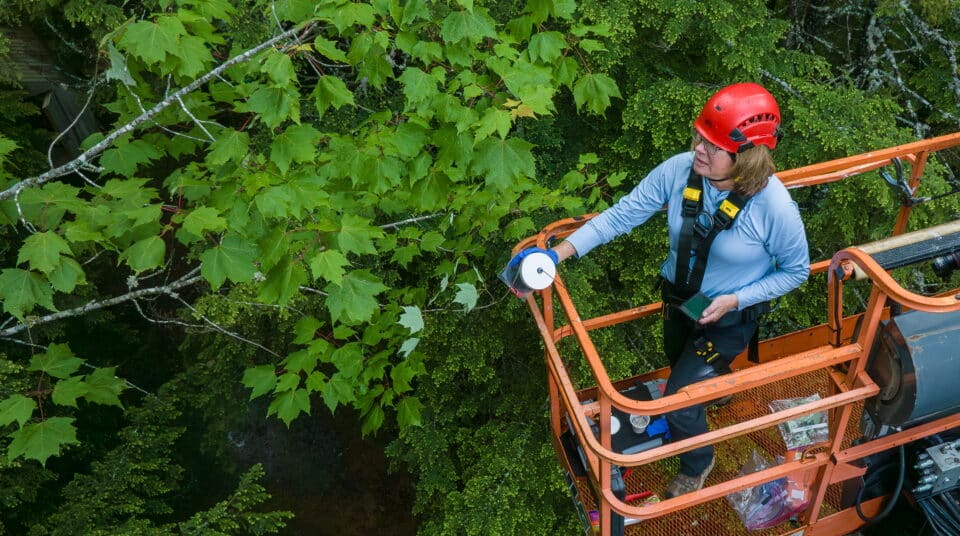
Field work in the lower canopy of Howland Forest, Maine.
photo by Charlie Nutting
Download the comments document
Woodwell Climate Research Center (Woodwell) appreciates the opportunity to comment on the proposed rule regarding the Organization, Functions, and Procedures; Public Notice and Comment for Standards, Criteria, and Guidance Applicable to Forest Service Programs. As a scientific research organization dedicated to conducting science for solutions at the nexus of climate, people, and nature, Woodwell consistently advocates for robust, science-informed, and transparent programs for long-lasting sustainability and the benefit of the public.
Introduction
Public participation in formulating land management policies and guidelines, including consultations with Indian Tribal governments, has been a feature of the U.S. Forest Service for more than 100 years, and is codified in the Forest and Rangeland Renewable Resources Planning Act of 1974, as amended (16 U.S.C. 1612(a)). Public participation in federal land management allows policies to be based on considerations of those most affected by the policies, and generally results in more effective land management decisions.
Currently, the Forest Service is obligated to notify the public and seek comments on changes related to “standards, criteria, and guidelines,” or more specifically, any rescissions or removals from the Forest Service Manual or any changes to the Forest Service Handbooks. Under the proposed rule, these requirements would be substantially narrowed. Implementation of these new rules would replace public participation with directives from political appointees having little knowledge of the scientific basis for land management decisions, threatening the many public benefits of public forests, including protection of wildlife habitat, recreation, water supplies, and mitigating climate change, among others.
Woodwell strongly recommends the rescission of this proposed rule as the scaling back of public engagement contradicts the interests of the American people and the principles of scientific integrity. However, Woodwell does support the revision of the overly complex Forest Service Directive System to increase flexibility for local land managers to make decisions based on unique ecological conditions and land-use history, and urges the Forest Service to review and propose appropriate changes to this system to streamline Forest Service operations.
Scientific objection to the scaling back of public engagement
Transparency is an underpinning of scientific integrity, as well as ethical public service. Without strong public engagement, forest management will be driven by partisan agendas and political appointees rather than the relevant and impacted constituencies and technical experts. In any sweeping action conducted by the Forest Service, it is imperative that the process be fully transparent to ensure quality and integrity for the American people. The solicitation of public comments on such actions offers a well-rounded pool of expertise to advise decisions, offering perspectives that may not have otherwise been considered. This openness to interdisciplinary discourse is a core principle of science and the management of public lands.
The large body of ongoing scientific research that takes place on Experimental Forests located within Forest Service lands is an important consideration. These long-term studies have informed management practices for decades based on continuous data collection following management treatments to assess how different approaches affect timber production, wildlife habitat, carbon stocks, and other forest values over time. For example, long-term research at the Hubbard Brook Experimental Forest nestled within the White Mountain National Forest in New Hampshire has yielded world-class research on the impacts of management practices on nutrient cycling that is the foundation of forest growth. Without public support, sustainable resource use on federal forest lands will be threatened and replaced with extractive practices like timber and mining that are favored by this Administration, without consideration of long-term benefits.
The critical role of forests in carbon sequestration
Nationwide, the Forest Service manages about 24 million acres of old growth and about 67 million acres of mature forest—nearly two-thirds of the total area of all forests managed by the agency. Mature and old-growth forests, with their much older and larger trees, hold more carbon. Mature and old-growth forests are also more resilient and adaptive in the face of disturbances such as wildfires, which makes them a high priority for environmental protection.
Since 2001, forest fire carbon emissions have increased by 60 percent. It is projected that by mid-century, wildfires in the northern region of North America would alone contribute to a cumulative net source of nearly 12 gigatonnes of carbon dioxide emissions into our atmosphere, further exacerbating temperatures and subsequent wildfire ignitions.
Impacts on climate resilience and economic risk
Rules are weighted by considering cost-benefit analyses. An analysis of short-term economic gain, without a clear analysis of the longer-term impacts on economics, human health, livelihoods, etc., weakens the argument against this rule. Actions such as the rescission of the 2001 Roadless Rule have already demonstrated the harm that increased logging and other commercial activities pose to protected forests, with the anthropogenic influences that increase under these conditions (such as population density, a human footprint index, and roadless extent in our forests) having significant statistical correlations to wildfire occurrence.
These harmful short-term approaches to forest management will have irreversible negative impacts on climate resilience, the economy, and public health. Forest ecosystems provide a plethora of economic co-benefits, including livelihoods, biodiversity, food, and air and water filtration, all of which are threatened by the exacerbation of wildfires and forest degradation due to climate change. Over the last 15 years, 15,000 deaths have been attributed to wildfire particulate matter. Further, Woodwell research has found that from 2006 to 2020, the economic burden linked to climate change-induced wildfire particulate matter alone accumulated to $160 billion. These repercussions will only be amplified under conditions of increased carbon emissions driven by deforestation. Woodwell strongly objects to the narrowing of the disclosure requirements in regard to Forest Service operations so that the public may continue to advocate, in their own self-interest, against irresponsible forest degradation.
Reforming the Forest Service Directive System
While Woodwell strongly objects to the scaling back of public engagement outlined under this proposed rule, Woodwell supports the reformation of the Forest Service Directive System. The current Directive System encoded in the Forest Service Manual and the Forest Service Handbooks is exceedingly complex and fails to adequately reflect the unique circumstances of land management history and ecological processes, especially considering climate change and effects on future forests. Reforming this outdated guidance by consulting the latest science, and without increasing the influence of short-term political considerations, would undoubtedly help ensure the long-term sustainability of the use of public forest resources for the wider public rather than the enrichment of a few businesses or wealthy individuals.
However, it is essential that the Directive System retain its importance as more than just advisory. The phrase “This proposed rule would redefine the Forest Service Handbooks as advisory and informational guidance that employees may deviate from without documenting a justification,” dangerously weakens the role of the Directive System and must be stricken from the final rule. A justification documenting the scientific basis of decisions as well as the concerns of the public must remain a requirement of forest and project planning. In addition, Woodwell strongly urges continued consultation and coordination with Indian Tribal governments.
Conclusion
The proposed rule to revise the procedures in regard to the standards, criteria, and guidance applicable to Forest Service Programs would eliminate effective public input to forest and project plans in favor of the heightened influence of short-term political agendas. In practice, this would significantly weaken the role of science in decision-making, ultimately threatening the long-term sustainability of federal forest resources. In order to protect public participation, as well as ensure scientific integrity of forest management decisions, Woodwell urges the Forest Service to significantly revise this proposed rule as follows:
- Restore the value of public participation to federal forest decision-making for policy and management to ensure sustainable benefits from public forests, including protection of wildlife habitat, recreation, water supplies, and mitigating climate change, among others.
- Strike the proposal to “redefine the Forest Service Handbooks as advisory and informational guidance that employees may deviate from without documenting a justification” and eliminate the process by which political appointees having little knowledge of the scientific basis for land management decisions can issue directives.
- Reinforce the importance of scientifically guided directives and consultation with Indian Tribal governments within the Forest Service Directive System for the responsible management of forest resources for the public benefit.
Woodwell urges the Forest Service to revise this proposed rule to restore the values of public participation and scientific integrity to inform responsible and sustainable federal forest management. This proposed rule threatens the wellbeing of our forests and the wellbeing of our citizens and Indigenous communities in favor of benefiting an elite few. Instead, Woodwell advises the Forest Service to look to its own mission of “caring for the land and serving people” as it moves forward in this much-needed update to the Forest Service Directive System.