

Wildfire’s natural balancing mechanism is breaking down
In Canada’s boreal forests, climate change is impacting feedback loops that once regulated temperature rise


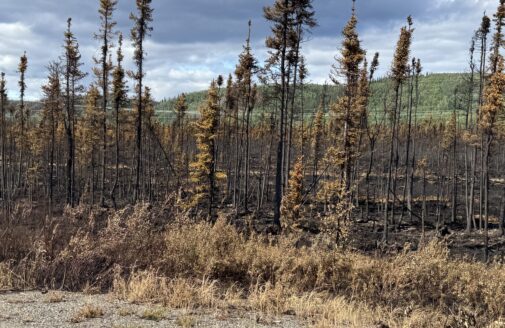
Fire in an Alaskan black spruce forest.
photo by Eric Miller
In 2023, Canada experienced its worst wildfire season to date. Fires raged across all 13 provinces and territories, breaking national records for burned area and carbon emissions.
Fires have a complex impact on both the global and regional climate. While fires contribute to warming through the release of stored carbon from trees and soil, they also create an unexpected cooling effect. Postfire changes to vegetation composition and coverage have an impact on albedo—the amount of sunlight reflected by a surface. The absence of the tree canopy no longer conceals snow, thus reflecting more incoming solar radiation which can cool the local environment.
“If you have a more reflective surface, like ice or snow in particular, it’s going to reflect more of that sunlight back to space, and so it’s going to have a cooling effect compared to if it wasn’t there,” says Rogers. “Because if it wasn’t there, then the darker land or the ocean would have absorbed more of it and heated.”
These changes in albedo have historically partially offset the warming caused by fire-induced emissions; however, climate change is disrupting this balancing effect.
In a newly published paper, co-authored by Woodwell Climate Senior Scientist Dr. Brendan Rogers, researchers found a 29% decrease of the regional climate-cooling impact of boreal wildfires since the 1960s. This represents one aspect of a critical shift in past ecosystem dynamics—not only is climate change responsible for rising global temperatures, but it is also weakening the natural mechanisms that once regulated this rise.
“The consequences of retreating snow cover become especially clear at the scale of individual fires,” says Max van Gerrevink, lead author of the study and postdoctoral researcher at Wageningen University and Research. “Historically, nearly half of all Canadian wildfires reached a natural climatic break-even point, where snow-driven surface cooling fully offset the warming caused by fire-related emissions. Today, that proportion has fallen dramatically, to only about one in four or five fires.”
The study used remote sensing to map the predicted changes in surface albedo over a 70-year postfire period assuming carbon dioxide emissions maintain current levels until 2050, then decrease, eventually reaching net zero by 2100. For Canada’s boreal forests, this means earlier snow disappearance rates, later snow onset and warming temperatures—all of which impact albedo.
When considered alongside a previous study co-authored by Rogers, the decreasing power of the cooling effect is projected to continue even further.
“Compared to pre-climate change, we’re talking about, over the next several decades… a 50% to 60% reduction due to earlier snowmelt,” says Rogers. “It’s important to be aware of this when you’re thinking about ‘What does this mean for the earth system,’ and ‘How might you manage these fires.’”
The implications of this finding are of growing concern, as warmer and drier weather conditions associated with continued climate change are subjecting Canada’s boreal forests to more severe and longer fire seasons. During the 2023 Canadian fire season, an estimated 647 teragrams of carbon were released—a number comparable to the annual fossil fuel emissions of the largest-emitting nations and only exceeded by India, China and the United States.
The cooling impact is declining, but the carbon impact is not, and it might even be growing because we’re seeing more permafrost emissions after wildfires.Dr. Brendan Rogers, Senior Scientist
With more carbon being released annually from worsening fire seasons and a diminishing climate-cooling effect, Canada’s boreal ecosystems are facing an amplified threat from exacerbated warming. As the study found, the subsequent weakening of the climate-cooling impact implies that contemporary boreal fires are, on average, twice as likely to result in a net climate-warming influence.
“Fires both warm through greenhouse gas emissions and cool through changes to land surface albedo,” says Rogers. “The cooling impact is declining, but the carbon impact is not, and it might even be growing because we’re seeing more permafrost emissions after wildfires.”
Rogers stressed the importance of considering albedo and carbon as two parts of a larger equation rather than two factors that act in opposition. This is due to the fact that albedo’s impact is limited to the geographic area where these fluctuations occur and therefore is not as widespread. Furthermore, he emphasized the need for measures that directly target carbon emissions in order to comprehensively address climate change.
“The reality is the spatial footprint from the albedo changes in Canada have very little impact on us down here in the lower 48 or other parts of the globe,” says Rogers. “And I think that’s important, because the carbon impacts are global and do impact us and everyone else on the planet.”


Latest in Arctic

- In The News