

Climate Risk Assessment: Holyoke, Massachusetts

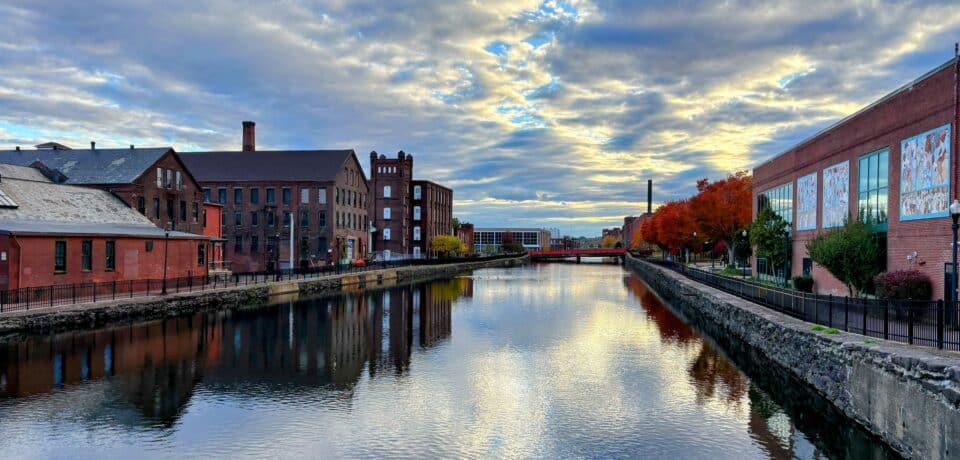
View of canal in Holyoke, Massachusetts. Photo by Ray Tan.

photo by Ray Tan

 
Download the assessment

Holyoke, MA climate risk assessment cover cover

The impacts of climate change on the frequency and severity of physical hazards are putting many communities at risk. As the threat of climate change grows, so too does the need for accessible information, tools, and expertise to support climate-resilient decision making across multiple scales, from communities to countries. Woodwell Climate Research Center believes there is a need to localize and customize climate risk assessments. This information is critical for local government leaders as they make planning decisions, but it is not available to all communities. Woodwell believes that this science should be freely and widely available. To address this gap, Woodwell works with communities across the world, including Holyoke, MA, to provide community climate risk assessments, free of charge.

Research area
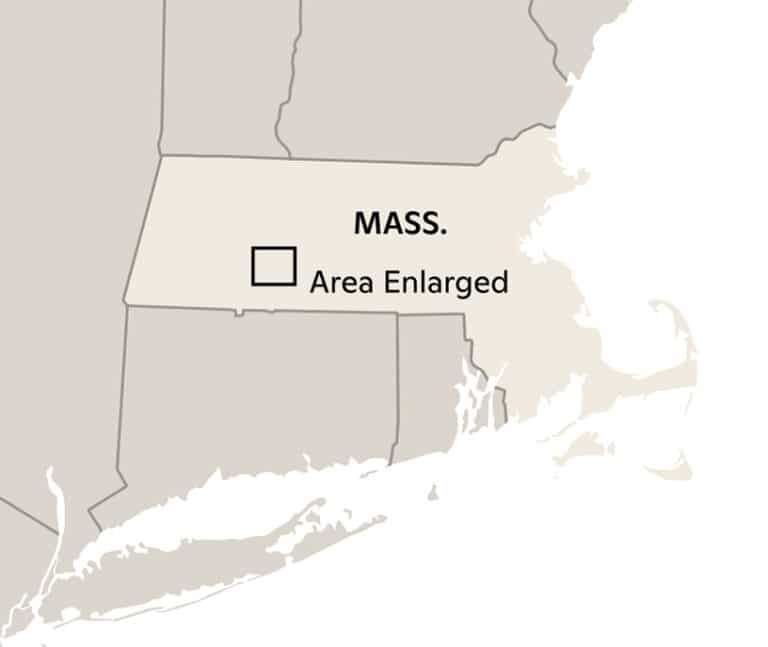
State map with Holyoke location
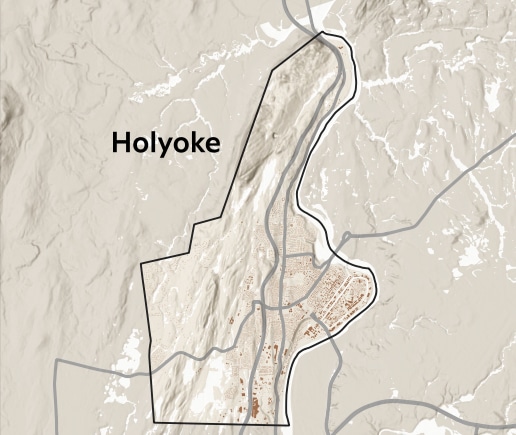
map with outline of the city of Holyoke

Results summary

As a result of climate change, flood risk is projected to increase for Holyoke. The probability of the historical 100-year rainfall event, a useful indicator of flood risk, is expected to more than double by mid-century and be nearly five times as likely by the end of the century. Streamflow for the Connecticut River is also projected to rise throughout this century with an increase of 9% by 2050 and an additional 5% by 2080. Both increases in streamflow and heavier rainfall will translate into greater flood depths and extent for Holyoke. Here we present our findings on extreme precipitation and flooding to help Holyoke in its plans to create a more resilient future for all residents.

Extreme rainfall

The Fifth National Climate Assessment shows that the U.S. Northeast region has already seen a 60% increase in annual precipitation, the largest in the U.S., occurring from the heaviest 1% of events.1 Future warming is expected to continue this trend of intensification, meaning more frequent and severe rainfall events. Here we use localized future precipitation data from downscaled global climate models to calculate the change in probability of extreme rainfall events. A detailed explanation of the precipitation data processing can be found in the methodology section of this document. In Table 1, we show the changes in the return period of the present-day (2000–2020) 100-year rainfall event for mid-century (2040–2060) and late-century (2070–2090). By mid-century, the present-day 100-year event will occur with a return period of 1-in-40. By late-century, the present-day 100-year event will become a 1-in-21 year event.

According to the National Atlas 14 published by the National Oceanic and Atmospheric Administration (NOAA), the 100-year rainfall amount, based on present-day rainfall records, for Holyoke is 8.1 inches (206 mm).2 For reference, the present-day annual average rainfall for Holyoke is 42.9 inches (1090 mm).3 By mid-century, the 100-year amount will increase to 10 inches (254 mm) and by late-century this will further rise to 11.8 inches (300 mm; Table 1).

Present 2040-2060 2070-2090
Return Period (yr) 1-in-100 1-in-40 1-in-21
100-Year 8.1 in (206 mm) 10 in (254 mm) 11.8 in (300 mm)
Table 1: Mid and Late-21st Century Change in Historical 100-Year Return Period and Rainfall. The mean future return period in years and rainfall amounts in inches and millimeters for Holyoke of the present-day, 2040–2060, and 2070–2090 100-year rainfall events.
Flooding

For a detailed explanation of the flood model input data and flood modeling procedures, please refer to the methodology section of this document.

Flood extent comparison

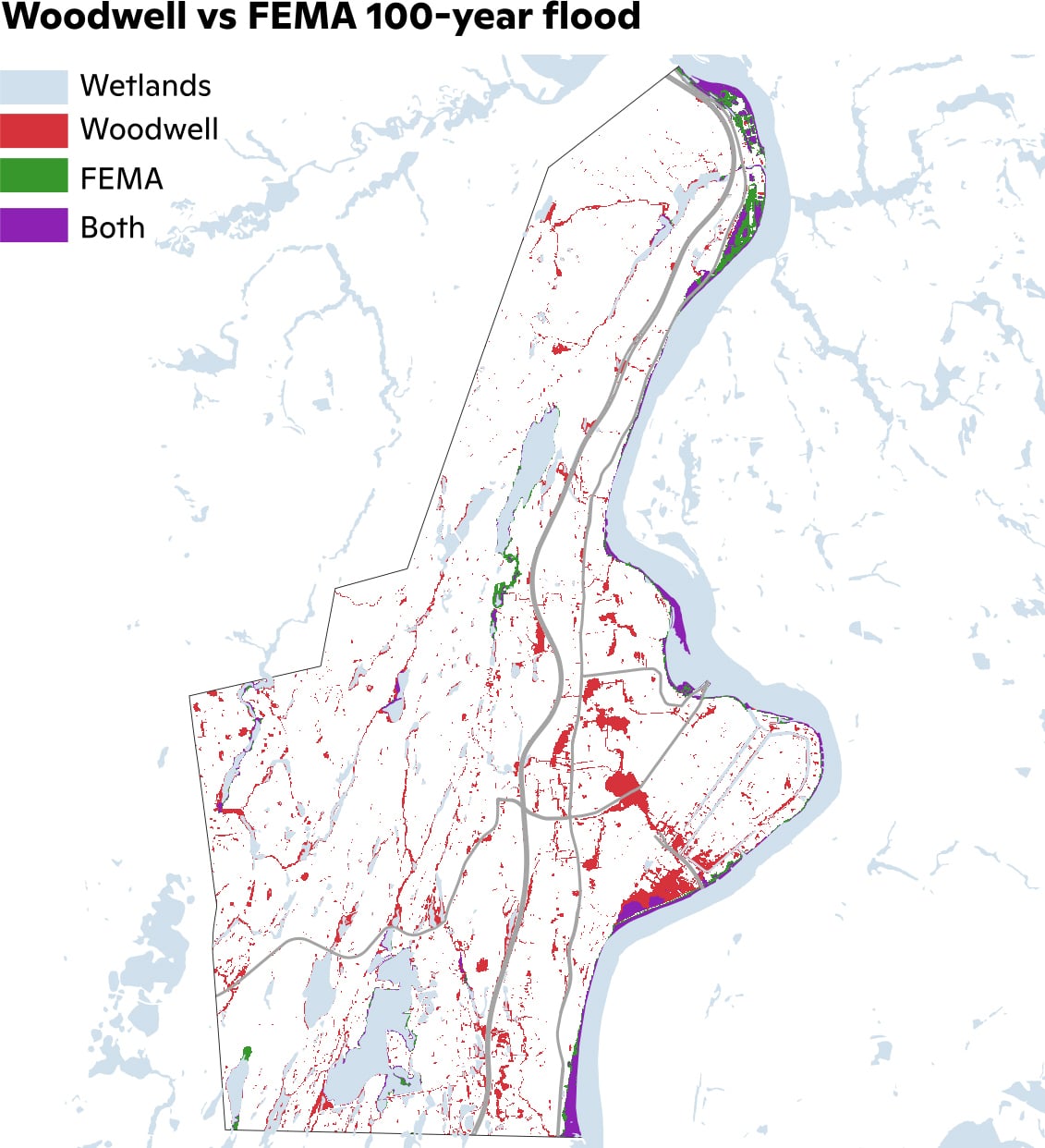
Before estimating future flood risk, we compare the present-day flood risk results against the Federal Emergency Management Agency (FEMA) flood maps as a validation exercise. FEMA maps are not ground truth data, but it is useful to compare various model results given the lack of appropriate reference data. Figure 1 shows the differences and similarities between FEMA’s estimate and Woodwell’s estimate of the 100-year flood extent for the Holyoke, MA region. Areas where only FEMA predicts flood risk are shown in green, areas where only Woodwell predicts flood risk are shown in red, and areas where both predict flood risk are shown in purple. Several patterns emerge when comparing the extents visually. The risk along the Connecticut River estimated by FEMA is greater than Woodwell estimates in some locations, in particular the northern section of Holyoke. This is likely a result of the digital elevation model (DEM) Woodwell uses which differs from FEMA models. The FEMA report was revised in 2023; however, the Connecticut River flooding source in Hampden County was last fully analyzed in 2006, so any changes in the last two decades are not reflected.4 Finally, FEMA shows no flood risk from pluvial (rainfall-induced) flooding, while Woodwell demonstrates extensive pluvial areas are vulnerable to flooding such as along Beech St. by the Roberts Field Sports Complex and along Main St. near Springdale Park. This is because FEMA does not account for pluvial flooding.

Woodwell vs FEMA 100-Year Flood map

Figure 1: Woodwell vs FEMA 100-Year Flood. The flood extent comparison between Woodwell’s flood model results and the current FEMA flood maps for Holyoke, MA. Areas where only FEMA predicts flood risk are shown in green, areas where only Woodwell predicts flood risk are shown in red, and areas where both predict flood risk are shown in purple. The Woodwell data shows the maximum extent based on both the 100-year pluvial/riverine floods.

Present and Future Flood Risk

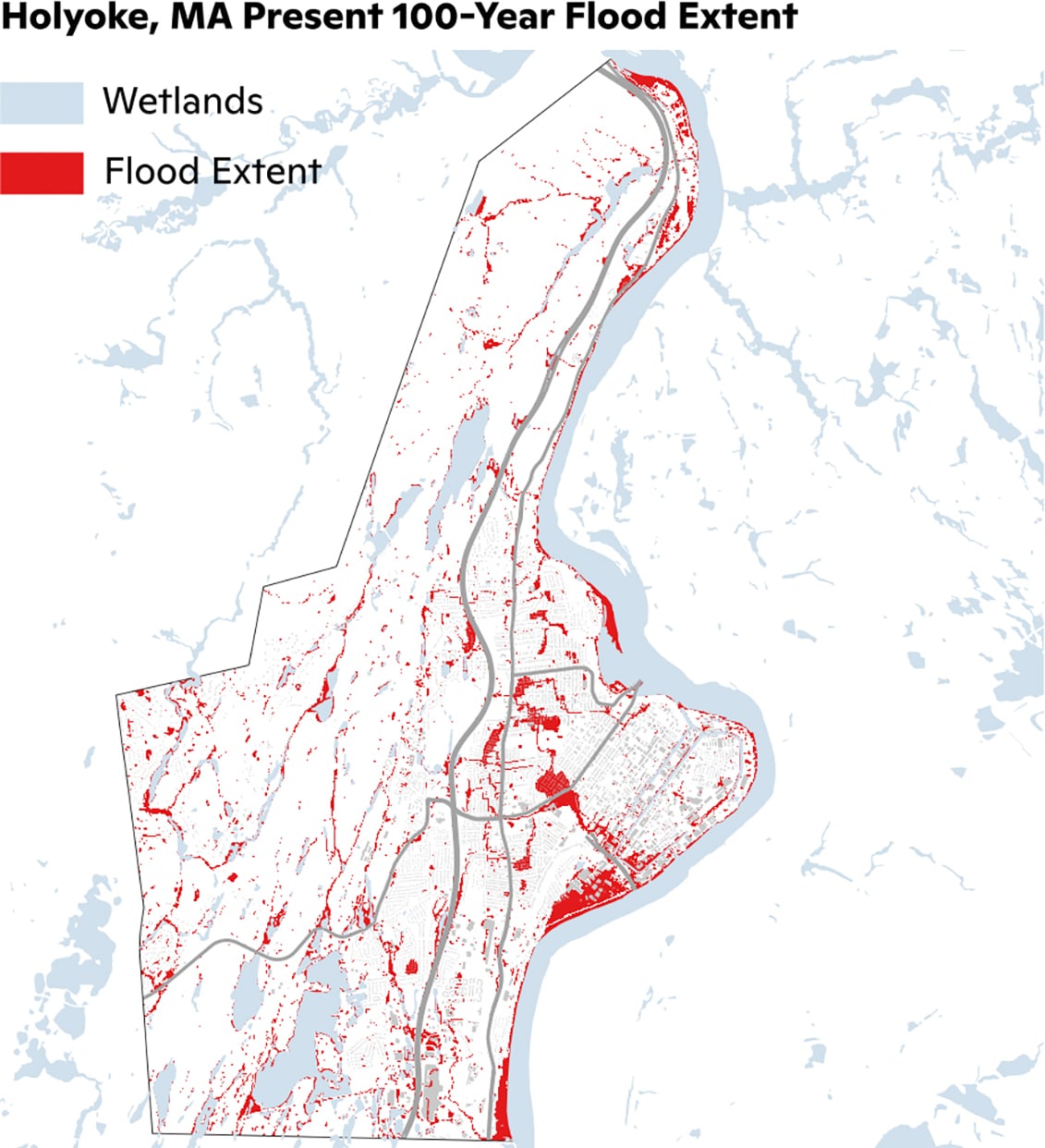
The primary flood risk in Holyoke, MA is pluvial flooding. In Figure 3, we show the extent of the 100-year flood from both streamflow and rainfall for Holyoke. Pluvial flooding risk is primarily apparent at the Roberts Field Sports Complex and the intersection of Beech St. and Franklin St. just to the north where the depth values are 10–13 ft (3–4 m). Flooding at Springdale Park is also substantial with values at roughly 11.5 ft (3.5 m). It is also worth mentioning that the Edward Nelson White School has some flooding (0.7 ft; 0.2 m) near the southeast corner of the building. The field area just north of the playground across from the school has about 1 ft (0.3 m) of flooding. It is possible flooding in the aforementioned locations would be less if existing stormwater components were included in the modeling effort. We mask wetland areas to focus the analysis on locations where human life and property are at risk.

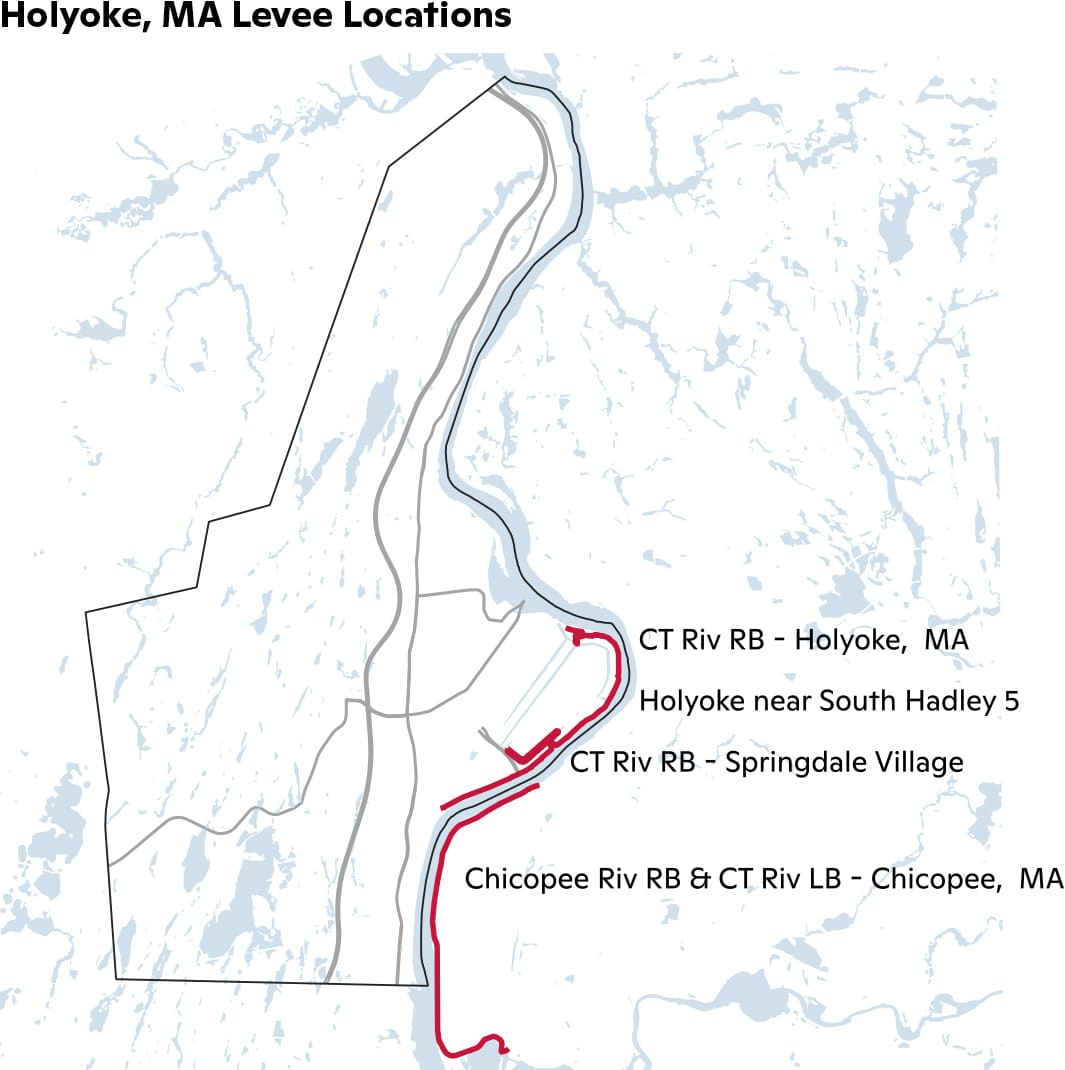
The National Levee Database (NLD) was used to include the many levees that surround the city of Holyoke into the DEM shown in Figure 2. We used levees on both sides of the Connecticut River to make the model as accurate as possible.

map of levee locations around Holyoke

Figure 2: Levee locations around Holyoke. The various levees around Holyoke are shown in red. The names used are provided by the National Levee Database (NLD).

The levees protecting Holyoke are a vital flood defense and none of them are overtopped in our flood simulation. The United States Army Corp of Engineers (USACE) conducted evaluations on these levees in 2012 and 2013 found that the levees are unlikely to breach if water levels reached the top of the levee; however, Chicopee Riv RB & CT Riv LB – Chicopee, MA, along with CT Riv RB – Springdale Village levees, have only experienced less than 50% of their load capacity during flood events. The levee CT Riv RB – Holyoke, MA has not exceeded 75% of its load capacity. This leads the USACE to note that a breach is possible on these levees.5 Lastly, Holyoke near South Hadley 5 does not have any accompanying report so we cannot make determinations about its risk. Water does pool on the landward side of some levees, but this is a result of pluvial flooding, not riverine. Overall, the levees surrounding Holyoke perform extremely well in flood simulations. There is potential that stormwater system upgrades can be made to better allow flow from behind the levee into the Connecticut River.

Present-Day 100-Year Flood map

Figure 3: Present-Day 100-Year Flood. The flood extent, quantified as having a depth of at least 0.5 ft (0.15 m), for Holyoke, MA. The maximum extent from the 100-year pluvial/riverine flood is shown.

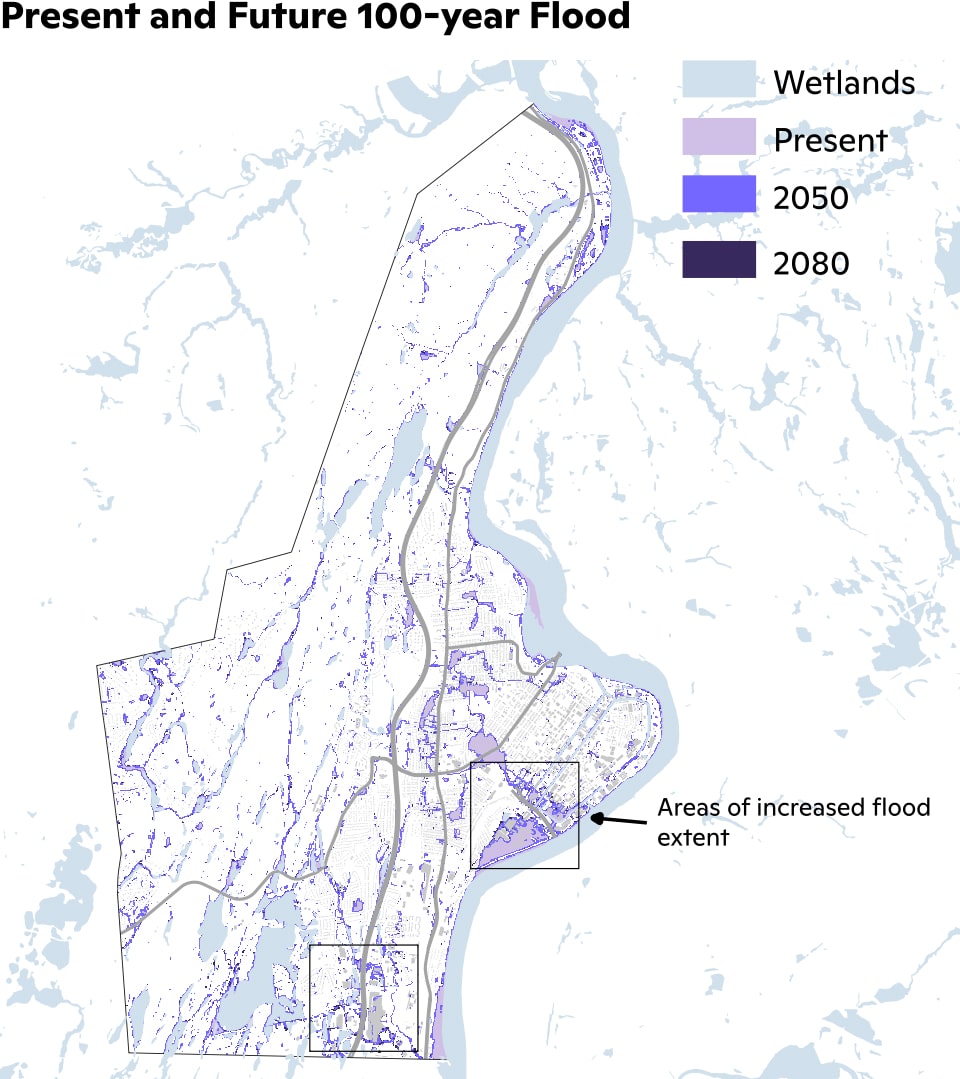
Future flood risk is primarily driven by increased rainfall and not from increased streamflow along the Connecticut River. The largest changes in extent, highlighted in Figure 4, are in South Holyoke where I-391 enters the city, and various areas in western Holyoke namely at the far southern extent of the city limits. This change in pluvial flood risk is due to projected increases in rainfall between 1.9 inches to 3.7 inches (48–94 mm) from the present-day period, as shown in Table 1. The riverine flood extent is impacted by an increase of streamflow (9.03% increase by 2050 and an additional 5.03% by 2080)6; however, all the levees around Holyoke withstand this increase with none of the levees being overtopped. Areas not protected by levees show slight increase in extent (less than 50 ft; 15.2 m beyond present extent). We also present several flood risk metrics in Table 2. Presently, 12% of the structures in Holyoke are vulnerable to the 100-year rainfall or streamflow event. That number increases to just over 13% by mid-century and then to just over 14% by late-century. The average flood depth in Holyoke has a minor increase of 0.12 ft (0.04 meters) through the 21st century, while the area flooded increases by about 240 acres by late-century, representing roughly a 2% increase in area flooded.

Present-Day and Future 100-Year Flood map

Figure 4: Present-Day and Future 100-Year Flood Holyoke, MA. The flood extent, quantified as having a depth of at least 0.5 ft (0.15 m), for Holyoke, MA. The maximum extent for the 100-year pluvial/riverine flood is shown. Areas with increased future extent are boxed.
Area Flooded 1,092 acres (8.5%) 1,229 acres (9.6%) 1,334 acres (10.4%)
Average Depth 2.7 ft (0.82 m) 2.76 ft (0.84 m) 2.82 ft (0.86 m)
Structures Flooded 1,404 (12.0%) 1,548 (13.2%) 1,677 (14.3%)
Table 2: Flood Risk Metrics for Mid and Late-21st Century in Holyoke MA. The acres of land area (excluding wetlands; and percent of total non-wetland area) flooded and the number of buildings (and percent of total structures) flooded for Holyoke of the present-day, 2040–2060, and 2070–2090 100-year rainfall and streamflow events.

Conclusion

Holyoke is currently at risk from flooding, primarily from rainfall, and this exposure will only increase under climate change. The results presented in this study were compared to FEMA’s flood maps, revealing significant discrepancies primarily due to the exclusion of pluvial flooding in FEMA’s analysis. Our findings show an expected increase in the frequency and intensity of heavy rainfall with the probability of the present-day 100-year rainfall event to be more than twice as likely by the mid-21st century and about five times as likely by the end of the century. This report provides insight into the vulnerability of the city of Holyoke, where an increasing number of buildings and areas will be exposed to flood waters by the end of the century. Lastly, the 100-year streamflow of the Connecticut River is expected to increase 9.03% by 2050 and an additional 5.03% by 2080, but are not projected to overtop Holyoke’s levee system.

Read the full assessment with methodology section.


1 Marvel et al. (2023). Ch. 2. Climate trends. In: Fifth National Climate Assessment. Crimmins, A.R., C.W. Avery, D.R. Easterling, K.E. Kunkel, B.C. Stewart, and T.K. Maycock, Eds. U.S. Global Change Research Program, Washington, DC, USA. https://doi.org/10.7930/NCA5.2023.CH2

2 NOAA calculates extreme rainfall frequencies with all available station data.

3 Period of record is 11/1902 through 12/2006. More information can be found here: https://wrcc.dri.edu/cgi-bin/cliMAIN.pl?ma3702

4 Flood Insurance Study Hampden County, Massachusetts Volume 1 of 5. Federal Emergency Management Agency. June 7, 2023. Flood Insurance Study Number 25013CV001C.

5 The USACE summary reports are available for each levee from the National Levee Database. https://levees.sec.usace.army.mil

6 Palmer and Siddique 2019: Estimating Future Changes in 100-year Floods on the Connecticut and Merrimack Rivers. Massachusetts Department of Transportation. https://www.mass.gov/files/documents/2019/12/10/EstimatingFloodsFinal Nov_2019%20.pdf