

Submitted comment on Special Areas; Roadless Area Conservation


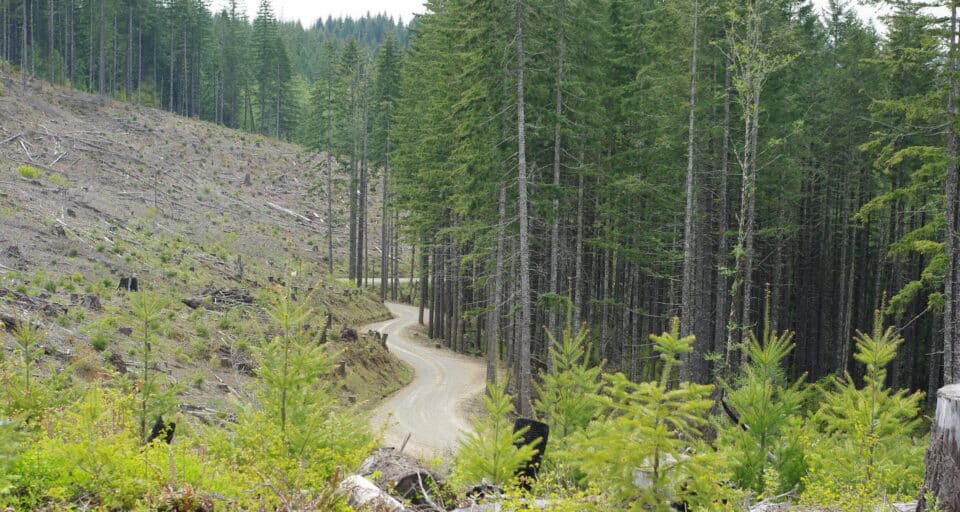
Logging area in the Northern Oregon Coast Range on the border of Washington and Yamhill counties, May 2010.
photo by M.O. Stevens (CC-BY-SA-3.0,2.5,2.0,1.0)
Download the comments document
Woodwell Climate Research Center (Woodwell) appreciates the opportunity to comment on the U.S. Forest Service’s proposed rule, Special Areas; Roadless Area Conservation. As a scientific research organization dedicated to understanding risk and promoting resilience, Woodwell consistently advocates for robust, science-informed, and publicly accessible data for long-lasting sustainability and the benefit of local communities.
Since 2001, the Roadless Rule has protected more than 40 million acres of forest from commercial logging, allowing the land to support other uses such as wildlife habitat, recreation, and watershed protection. Of the comment letters received in response to the 2025 notice of intent to prepare an environmental impact statement to repeal the Roadless Rule, the vast majority were opposed to the proposed rescission, while approximately 1 percent were in support.
The proposed rule states its intent to increase the total annual National Forest System sawtimber harvest by about 5 to 10 percent. Executive Order 14225, however, dictates a proposed 25 percent (or larger) increase in logging from federal lands. The high economic value of the large trees and mature forests means Roadless Areas are likely to be targeted to meet that 25 percent threshold, far surpassing the misleading 5 to 10 percent increase outlined in the proposed rule. Any increase in logging will cause widespread harm and has the potential to be expanded in the future.
Large trees and mature forests contain large quantities of carbon in their biomass and soils. According to recent studies, Inventoried Roadless Areas of the conterminous U.S. (excluding Alaska) contain 33.6 million acres of mature and old-growth forest, with a carbon stock of 2.0 billion metric tons. Of particular concern is the large Roadless Area of the Tongass National Forest in Alaska which includes 16.6 million acres of forest, most of which is mature or old growth. More than 9 million acres of forest in the Tongass is protected by the Roadless Rule. Tongass contains almost as much carbon stock as the entire rest of the National Forest system–2.7 billion tons–making it the most important and largest undisturbed forest in the U.S.
Woodwell urges the U.S. Forest Service to preserve the Roadless Rule, recognizing that the existing national guidelines are critical for implementing policies that are in the best interest of the public and forest health across the country.
The Critical Role of Forests in Carbon Sequestration
The proposed rule fails to recognize the integral role that forests play in carbon sequestration. Federal forests hold immense carbon storage and climate mitigation potential. They absorb the equivalent of roughly 3 percent of U.S. emissions from fossil fuel burning each year, with mature and old-growth forests responsible for the majority of that absorption. Mature and old-growth forests, with their much older and larger trees, hold more carbon than younger forests. Nationwide, the U.S. Forest Service manages about 24 million acres of old growth and about 67 million acres of mature forest-nearly 2/3 of the total area of all forests managed by the agency. Forests and related ecosystems represent the greatest potential in land-based carbon emissions reductions on Earth.
Under conditions of increased temperatures further amplified by increased carbon emissions driven by deforestation, burned area from wildfires is expected to increase. Since 2001, forest fire carbon emissions have increased by 60 percent. It is projected that by mid-century, wildfires in the northern region of North America would alone contribute to a cumulative net source of nearly 12 billion metric tons of carbon dioxide emissions into our atmosphere, further exacerbating temperatures and subsequent wildfire ignitions. Woodwell research has found that from 2006 to 2020, the economic burden linked to climate change-induced wildfire particulate matter alone accumulated to $160 billion. This economic impact of wildfire is also expected to increase as the climate warms and extreme weather events become more frequent.
Scientific Objection to the Proposed Rescission of the Roadless Rule
The proposed rule argues that better access via roads facilitates more active management, including vegetation management to address “overgrown and fuel-loaded national forests.” However, scientific literature does not support the outlined rationale of allowing more access and logging of relatively undisturbed and remote forest areas in order to reduce wildfire risk. Studies have shown that wildfires are most often caused by humans, and thus, areas with road access have more ignitions and wildfires than more remote areas. Despite claims outlined in this proposal, mechanical thinning is not a universally effective wildfire mitigant and must be carefully managed. Mechanical thinning and other methods of active forest management increase forest resilience in some cases, but should not be considered a general recommendation. Further, mechanical thinning to reduce wildfire risk is already allowed under the current provisions, making this justification insignificant. Management decisions at the local level can help determine when active management is needed to intervene in selective cases.
Mature and old-growth forests are more resilient and adaptive in the face of wildfires compared to more actively managed (i.e., logged) forest lands. Logging larger trees that are more resistant to wildfire damage and leaving smaller trees standing among the logging debris raises the risk of future wildfire because of the presence of fuel on or near the ground. When fires occur in mature and old-growth forests, they tend to be less severe, which makes these forests a high priority for environmental protection.
Further, to address the principal cause of climate change, emissions of carbon dioxide, most peer-reviewed studies conclude that it is more effective to let forests grow without the management interventions or harvesting that would increase emissions and contribute to warming. These studies indicate that it would take decades to centuries to restore the carbon stocks lost to harvesting live trees–particularly large trees–even if fully accounting for the temporary storage of carbon in harvested wood products. As the impacts of climate change become more extreme, we should prioritize protecting mature and old-growth forests on federal lands, not harvesting them. Increased logging is the single greatest future threat to these forests and the carbon they hold, and it is the threat we most directly control.
Policy Shortcomings and Impacts
National policies that mandate increased logging do not accomplish one of the main justifications for rescinding the Roadless Rule: allowing decisions to be made locally. Rather, increasing timber targets would force managers to increase logging as the principal use of forests, benefitting only a few commercial interests rather than the many other activities of value to citizens.
The protection of these vital forest ecosystems is integral for the plethora of economic co-benefits they provide, including livelihoods, biodiversity, food, and air and water filtration. The National Environmental Protection Act (NEPA) and the Endangered Species Act (ESA) ensure that land management projects do not cause unintended, unnecessary, or damaging impacts on ecosystems that are valued for non-timber services like wildlife habitat or water quality. As well as adhering to federal regulations regarding environmental impacts, NEPA review has been a highly effective way for facilitating public input. However, due to the promotion of new categorical exclusions for timber harvesting under Executive Order 14225, there is a significant likelihood that NEPA reviews will be bypassed or excluded in roadless areas to limit public input and speed project implementation.
Further, because of the extensive staff cuts across the U.S. Forest Service and Bureau of Land Management within the past year, it is doubtful the federal government will be able to effectively and responsibly prepare timber sales and monitor the project implementation. Although most loggers are responsible stewards of the land, it is likely that project boundaries will not be adhered to in all cases. Lacking direction or oversight, it will be tempting for loggers to harvest trees outside of project boundaries and/or select larger trees to harvest that should be left standing to provide important ecosystem functions such as wildlife habitat, resistance to wildfire, and carbon storage. By prioritizing the short-term economic gains associated with harmful activities such as logging in the utility of this proposed rule, long-term economic harms will be perpetuated, ultimately hurting the American economy and subsequently, its own citizens.
The draft Environmental Impact Statement (EIS) associated with this proposed rescission of the Roadless Rule fails to adequately examine these integral environmental impacts and considerations. There are many unanswered questions that must be addressed, including:
- What are the environmental impacts of increasing road density, including increased risk of fire ignitions?
- What types of logging will occur and what specific areas will be logged?
- Do the U.S. Forest Service and Bureau of Land Management (BLM) have capacity to manage increasing timber sales in remote areas? If not, how will loggers be directed and monitored?
- Will all projects require NEPA review, including analysis of effects on individual species as defined by the ESA?
- Will the transition to local decision-making along with increased national and regional logging mandates facilitate unacceptable degradation of mature and old-growth forests?
- What are the net carbon dioxide emissions from increased logging of mature and old-growth forests?
Woodwell strongly urges a revised version of the EIS, one that clearly addresses the questions outlined above, to be published in response to public comments.
Conclusion
As the impacts of climate change become more extreme and damaging, the United States should prioritize protecting mature and old growth forests on federal lands, not harvesting them. Woodwell strongly urges the U.S. Forest Service to consider the overwhelming interests of the public at large, not just the economic interests of the forest industry. Specifically, Woodwell strongly urges U.S. Forest Service to:
- Preserve the 2001 Roadless Rule through the “Alternative 1: Implications for Forest Vegetation, Forest Health, and Carbon” pathway outlined in the EIS. This will protect currently roadless areas from the establishment of new roads and ensure that any increase in timber harvesting from federal forests is conducted within existing multiple use areas that currently allow logging, following the guidelines established in previously approved forest plans.
- Require that each project include clear guidelines and safeguards to avoid excessive logging and degradation of forests, particularly in Inventoried Roadless Areas that contain the mature and old-growth forests that have higher value to society than to specific industrial entities.
- Mandate that timber targets take account of the federal capacity to effectively plan and review all projects, rather than simply following arbitrarily established timber targets such as increasing harvest across all forests by a fixed amount.
- Require that forest plans and projects assess the impacts of decisions on carbon stocks and emissions. Although individual projects may not have discernable impacts on climate, collectively their impact is significant.
- Rewrite the EIS associated with this proposed rule in a manner that is comprehensive and based on the best available science. The EIS must include a strong recommendation to continue NEPA reviews for all projects without exceptions.
- Establish guardrails that allow for the consideration of the impacts of projects, and the aggregate of projects, on the larger regional and national domains. An example of guardrails that could be established can be found here.
Due to the national significance of local decisions about land use and management, which have impacts far beyond project boundaries, it is imperative to have clear and consistent national guidelines to adhere to when planning logging or other extractive activities on forest lands. This does not mean that some flexibility cannot be allowed to consider local conditions. The Roadless Rule has been a resounding success over several decades, protecting some of the most critical federal forest resources from land management activities that typically destroy or degrade healthy and productive ecosystems. Rescinding the Roadless Rule would harm many public uses of the land, cause significant emissions of greenhouse gases, and destroy critical habitat for many species of wildlife. The clearly articulated assessment of these impacts must be required by national standards so that public interests can be protected from the consequences that arise from increasing logging and other extractive industries.