

Submitted comment on proposed new State Forest Law and Policy information collection request


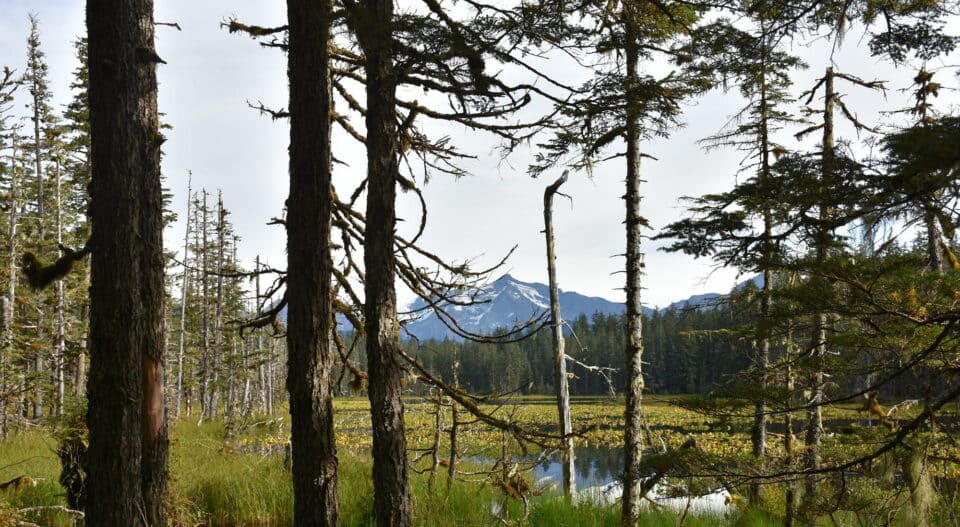
A view from the Situk Lake Trail in Yakutat, Alaska, Tongass National Forest. (Forest Service photo.)
photo by Paul A. Robbins, CC 2.0
Download the comments document
The Forest and Rangeland Renewable Resources Planning Act of 1974 and the Forest and Rangeland Renewable Resources Research Act of 1978 complement one another to create a comprehensive program of inventories, research, and dissemination of data pertaining to our Nation’s natural resources. The Cooperative Forestry Assistance Act of 1978 promotes federal-state-private cooperation in the management of forests. However, while the rationale for this information collection regarding State Forest Law and Policy cites these, amongst other laws, it displays no legal precedent for the comprehensive collection of information about state policies it proposes. The potential outcomes of collecting this information on “how laws, public policies, regulations, and other factors influence and affect the use, ownership, and management of forest lands” must be carefully considered.
Our nation’s forests, the ecosystem services they provide, and the effects of climate change that threaten them, are not bound by state borders. These forests represent a critical role in storing atmospheric carbon, a role which is increasingly threatened by exponential wildfire fire activity due to human-induced climate change and direct anthropogenic activity such as land-use change and logging. Wildfires present extreme danger to human health, which is only expected to increase. Already, 15,000 deaths have been attributed to wildfire particulate matter over the last 15 years. Even without any major escalation in the deterioration of our forests, the scale and impact of wildfire smoke on human health is projected to increase. To protect our forests and combat wildfire threats, this comprehensive state policy database has the potential to assist in state collaboration, which Woodwell strongly supports. However, in order to precautionary provisions so as to promote an appropriate balancing of environmental and economic missions in this information collection.
Scientific Objection to the State Forest Law and Policy Information Collection Outlined Purposes
The outlined purposes of this information collection place emphasis on enhanced productivity and economic returns, while the critical role that forest policy plays in environmental protection falls to the wayside. Despite citing the Forest and Rangeland Renewable Resources Planning Act of 1974, which specifically states the necessity of “an analysis of the potential effects of global climate change on the condition of renewable resources on the forests and rangelands of the United States” as well as “an analysis of the rural and urban forestry opportunities to mitigate the build up of atmospheric carbon dioxide and reduce the risk of global climate change,” there is no outlined purpose of this information collection that addresses the global climate crisis or other non-commodity services. The singular mention of the “provision of ecosystem services” inadequately encompasses these dire circumstances, especially given the recent record of Administrative actions that threaten forests by expanding logging activities, such as President Trump’s Executive Order Immediate Expansion of American Timber ProductionThe Critical Role of Forests in Carbon Sequestration
The proposed information collection fails to recognize the integral role that forests play in carbon sequestration. Nationwide, the Forest Service manages about 24 million acres of old growth and about 67 million acres of mature forest – nearly 2/3 of the total area of all forests managed by the agency. Mature and old-growth forests, with their much older and larger trees, hold more carbon. Mature and old-growth forests are also more resilient and adaptive in the face of disturbances such as wildfires, which makes them a high priority for environmental protection.
Woodwell researchers have also found that even beyond the cooling effects of sequestering carbon, forests provide biophysical cooling effects on a local and global scale. This unique quality promotes local climate stability, reducing extreme temperatures year-round.
Since 2001, forest fire carbon emissions have increased by 60 percent. It is projected that by mid-century, wildfires in the northern region of North America would alone contribute to a cumulative net source of nearly 12 gigatonnes of carbon dioxide emissions into our atmosphere, further exacerbating temperatures and subsequent wildfire ignitions.
Impacts on Climate Resilience and Economic Risk
The protection of these vital forest ecosystems is integral for the plethora of economic co-benefits they provide, including livelihoods, biodiversity, food, and air and water filtration. Forests and related ecosystems also represent the greatest potential in land-based carbon emissions reductions on Earth, a resource that is desperately needed to meet the global mission to not exceed either the 1.5°C or 2°C global emissions thresholds.
Under conditions of increased temperatures, which would be further amplified by increased carbon emissions driven by deforestation, burned area from wildfires is expected to increase. Woodwell research has found that from 2006 to 2020, the economic burden linked to climate change-induced wildfire particulate matter alone accumulated to $160 billion. This economic impact of wildfire is also expected to increase as the climate warms and extreme weather events become more frequent.14 By prioritizing the short-term economic gains associated with harmful activities such as logging in the utility of this information collection, long-term economic harms will be perpetuated, ultimately hurting the American economy and subsequently, its own citizens.
If this information collection is to be a truly useful tool for the long-term economic and environmental benefit of the American people, it must properly value forest resources based on modern scientific understanding, which includes the integration and consideration of global climate change.
Conclusion
The proposed information collection of State Forest Law and Policy is not necessary for the proper performance of the functions of the Forest Service, but it does present an advantageous opportunity for practical and scientific utility within the stated purposes. In order to enhance the quality, utility, and clarity of this information to be collected, as well as ensure the integrity of this information collection, Woodwell urges the Forest Service to enact a formal regulation to build this policy database, which explicitly outlines the following:
- A mission that explicitly balances the benefits of forest preservation in combatting global climate change with economic opportunity, as well as encourages collaboration and the establishment of regional partnerships amongst the States and private entities with the assistance of the Forest Service to protect and manage forest resources.
- A condition that this request for information from state agencies or departments extends not only to the department responsible for forest management, but also other departments or agencies responsible for water resources, wildlife, recreation, and climate policies, so as to capture the various and diverse policy perspectives that exist in regard to forest resources.
- A requirement that this policy database and its outlined mission be a publicly available resource, so that researchers and the public can properly track policy activity associated with their forests.
- The necessity of a contract for nongovernmental science and economic research institutions to create this policy database based on the input from state contributors, as opposed to a strictly Federal government activity, so as to strive for an objective and apolitical resource.
- A provision which outlaws the federal government from using this resource to pressure the administration of any state to change their forestry laws to comply with the political agenda of any acting federal administration.
Woodwell urges the Forest Service to preemptively act to combat the potential misuse and abuse of this State Forest Law and Policy dataset so as to ensure that short-term economic gain does not overwhelm nor overcome sustainable forest management. Encouraging forest users to find loopholes or potential exploitation points, or even pressuring states to change their laws, in order to increase logging and other harmful activities, would amplify global climate change and the risk of wildfire. This would ultimately produce negative economic outcomes that would far outweigh short-term gains. It is imperative that the Forest Service’s information collection on State Forest Law and Policy facilitate, rather than hinder, the creation of comprehensive policy frameworks encouraging a responsible balance of economic activity and environmental protection for the well-being of American citizens.