

Takeaways from the 30th annual climate COP
A Woodwell delegation attended this year’s conference in Belem, Brazil to advance science-backed policy


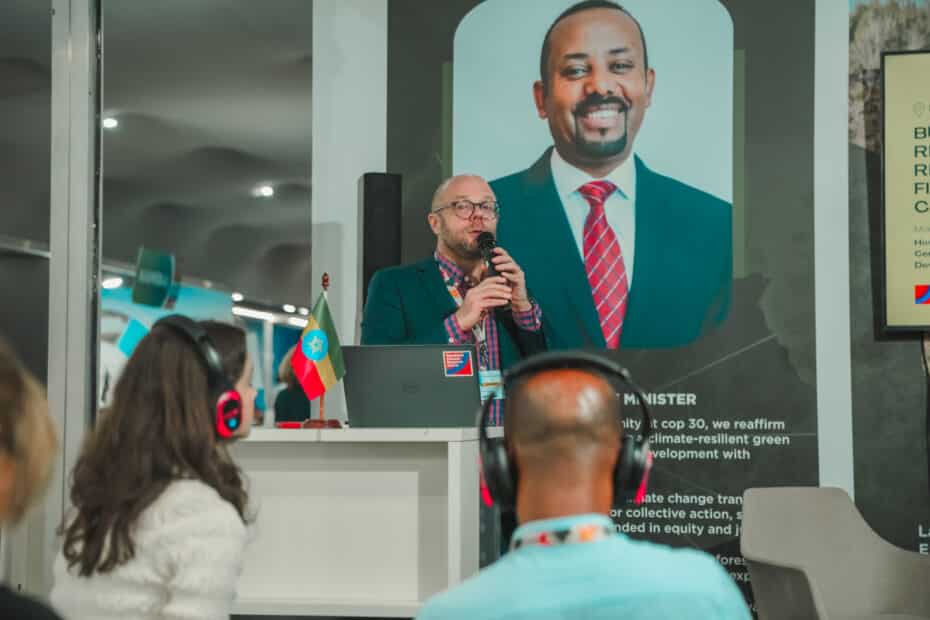
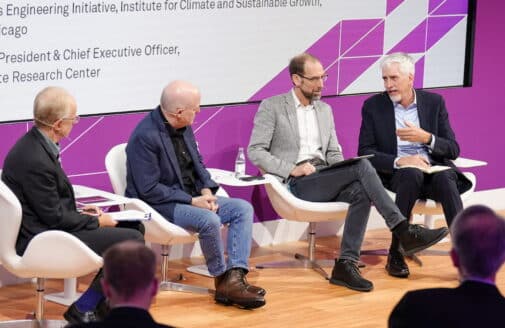
Matti Goldberg speaks before an audience at Ethiopia’s pavilion during COP30.
photo by Hands Photography
November 2025 marked the 30th convening of the United Nations climate conference (COP). Woodwell Climate has been a pivotal player in the annual COP since our founder, Dr. George Woodwell and early staff members, played an instrumental role in the creation of the United Nations Framework Convention on Climate Change (UNFCCC) which enacts the annual conferences. This year was an important milestone for Woodwell due to its focus on tropical forests and nature-based solutions. Woodwell Climate sent 17 staff and scientists to Belem, Brazil, where they spoke at 52 events, and continued the Center’s legacy of advancing science-informed climate policy. Here are 4 takeaways from this year’s conference.
1. COP30 was Brazil’s time to shine
As host country, Brazil used COP30 to vault themselves into global leadership, to press the importance of international cooperation, and to build bridges between the global north and south. COP30 served as the launchpad for several forest-centered initiatives spearheaded by Brazil, including the Tropical Forests Forever Facility, a new financial solution that would pay tropical countries to keep their forests standing. Woodwell Senior Policy Advisor Frances Seymour and Associate Scientist Dr. Glenn Bush provided input and technical assistance to help launch the TFFF. In addition, Brazil launched a global initiative on wildfire resilience and a global coalition to harmonize carbon markets. Brazil also announced that they will publish two roadmaps in 2026: one to chart the course towards ending halting and reversing deforestation, and another for transitioning away from fossil fuels.
2. NDCs were one of the trickiest issues at COP30
Nationally Determined Contributions (NDCs) are the promises each party country to the UNFCCC makes every five years, to reduce their emissions. Ahead of COP30, countries were supposed to submit their third round of NDCs to raise their ambition. However, many NDCs were missing by the start of the conference, and those presented would reduce emissions only by 10-12% from 2019 levels by 2035, a far cry from the 60% the IPCC says is needed to limit global warming to 1.5 degrees Celsius. The European Union, Latin America, and small island nations attempted to advance this conversation but this was opposed by major emerging economies, who view the NDCs as a commitment to be worked out at the national level.
During several speaking events, Woodwell Senior Research Scientist Dr. Christina Schaedel emphasized the importance of including growing emissions from Arctic permafrost thaw in NDCs and estimates of the global carbon budget. Schaedel’s research has focused on modeling the contributions of permafrost-thaw emissions to sea level rise, temperature increases, and damage costs.
Given strong opposing interests, the issue of NDCs was not resolved by the end of the conference. The UNFCCC instead set up two workstreams to discuss NDC ambition: the Global Implementation Accelerator and the Belem Mission to 1.5. Details about what shape these discussions will take is still forthcoming.
3. Climate finance took center stage
During COP29 in Baku, Azerbaijan, countries agreed to mobilize $1.3 trillion per year by 2035 for climate adaptation and mitigation. Many hoped COP30 negotiations would identify funding sources to reach that goal: developing countries wanted public finance from industrialized countries, while industrialized countries insisted that finance must also come from major emerging economies and non-governmental sources. Again, the official outcome was to launch work programs to address the issue outside of conference. The programs created will tackle questions of finance obligations and climate-friendly investments.
Woodwell experts provided important contributions to the complex climate finance debate: Seymour played a lead role in the Forest Finance Roadmap for Action highlighted by a coalition of 34 countries, and Vice President of Science, Dr. Wayne Walker introduced a roadmap for carbon and biodiversity credits that takes a community-based and Indigenous-led approach for generating climate finance.
4. Measurements of progress towards resilience
Countries did reach an agreement on indicators to help measure progress on adaptation and resilience goals in sectors like water, agriculture, health, ecosystems, infrastructure, poverty eradication, and cultural heritage, as well as on resilience efforts, including risk assessments, adaptation planning, and early warning systems. 59 indicators were identified for countries to use in their future progress reports. Woodwell Climate has been supporting adaptation efforts through the Just Access program, which provides cost-free risk assessments to local, state, and national governments around the world.
Next year’s COP will be hosted jointly by Türkiye and Australia in Antalya, Türkiye, and while the agendas are not fixed, the outcomes of this year’s conference have indicated that NDCs and climate finance will continue to be high priority issues. In addition, a new global stocktake, a required moment under the Paris Agreement to re-evaluate the state of the planet and progress towards goals, is on the horizon.