

Unaccounted emissions from abrupt permafrost thaw and wildfires could impact global carbon budgets
Researchers used a new model to more accurately predict the carbon impact of rapidly-warming Arctic


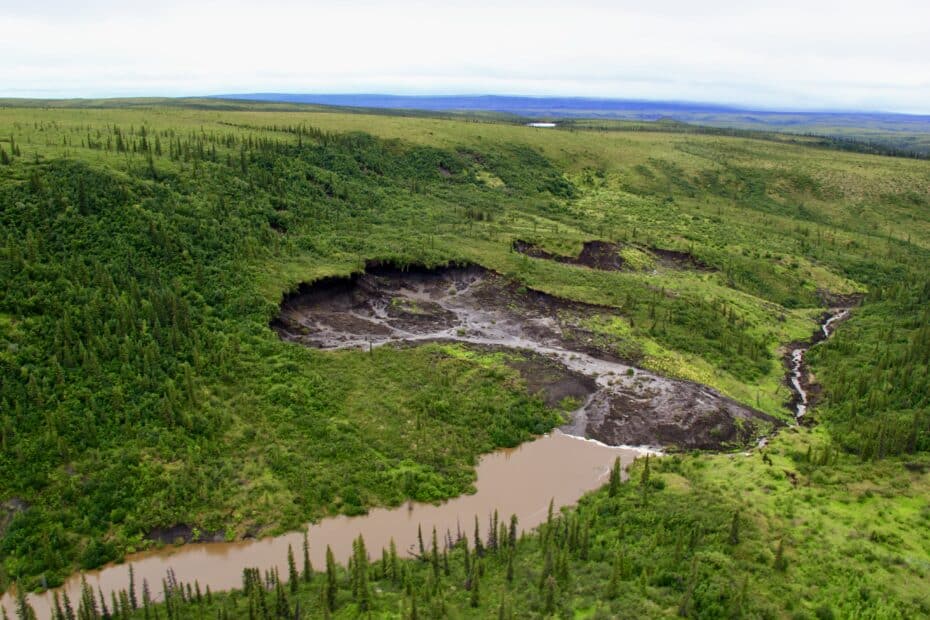
Thawing permafrost in Canada’s Northwest Territories
photo by Scott Zolkos
In a new study released this week in Nature Communications Earth & Environment, researchers assess the impact of a warming Arctic on global carbon emissions and find that carbon emissions from abrupt permafrost thaw and wildfire will substantially limit our ability to keep global temperature increase below 1.5° or 2° Celsius. When accounting for carbon emissions from abrupt permafrost thaw and intensifying wildfire regimes, the remaining carbon budgets to keep global temperatures below 1.5°C were reduced by about one quarter and by nearly one fifth for 2°C.
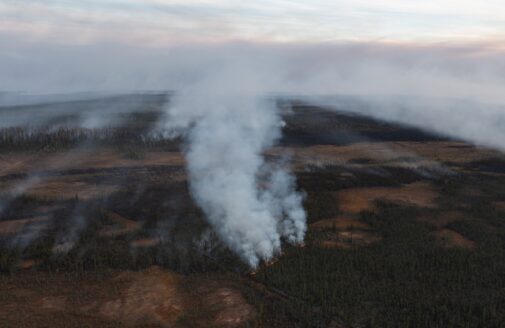
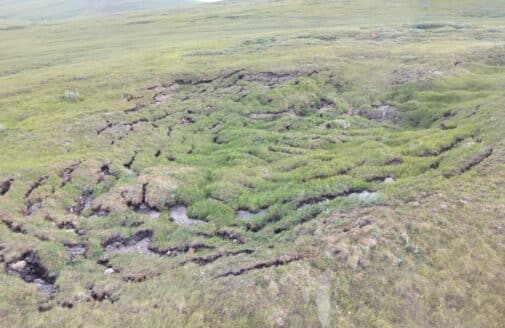
Abrupt thaw mainly occurs in ice-rich permafrost landscapes, where rapid thawing can cause the ground to collapse. This exposes deep carbon-rich soils to warmer temperatures, allowing large amounts of previously frozen carbon to be released over a short period of time and amplifying climate warming. At the same time, intensifying wildfires are emitting carbon to the atmosphere at the time of burning and further accelerating permafrost thaw by removing the insulating organic layer at the soil surface.
While existing research has recently led to the critical inclusion of projected carbon emissions from gradual permafrost thawing in global carbon budgets, the impact of abrupt thaw processes and wildfires are both largely missing from Earth System Models, hindering our ability to set sufficiently ambitious and accurate mitigation solutions. The study, which was led by Permafrost Pathways researchers at the Woodwell Climate Research Center and co-authored with the University of Colorado, Boulder and the International Institute for Applied Systems Analysis (IIASA) in Austria, calculates that these total permafrost thaw and wildfire carbon emissions could reach 63 Pg C for every degree Celsius of further global temperature increase. This is over double what is currently included in the Intergovernmental Panel on Climate Change (IPCC) projects. To put it another way, by the end of this century, these projected annual permafrost emissions could reach or exceed the current total annual emissions of a high-emitting nation such as the United States.
“Accurately accounting for land-based emissions directly affects whether remaining carbon budgets, as established by the Paris Agreement, are effective in restricting the planet’s temperature increase to below the 1.5°C and 2°C thresholds,” said Dr. Christina Schädel, lead author of the paper and Senior Research Scientist at Woodwell Climate Research Center. “As the Arctic continues to warm more rapidly than anywhere else on the planet, we must continue to research and support science-based solutions in the Arctic in order to mitigate the impacts of climate change on communities across the globe.”
“Estimates of remaining carbon budgets will continue to underestimate emissions unless the impacts of permafrost thaw and wildfire are fully included,” said Dr. Susan Natali, Senior Scientist and lead of Permafrost Pathways at Woodwell Climate Research Center. “Given the urgency of the climate crisis, and our rapidly shrinking window to limit its impacts and to respond to accelerating climate hazards, the global community must move quickly towards fully informed climate policy and accurate temperature goals.”