

Submitted comment on the updated definition of “Waters of the United States”


On January 5, Woodwell Climate submitted public comment to the U.S. Environmental Protection Agency’s (EPA) and U.S. Army Corps of Engineers’ (Army Corps) proposed rule to update the definition of “Waters of the United States” (WOTUS).
Introduction
The Sackett v. EPA decision in 2023 substantially limited federal protections for many wetlands and streams under the Clean Water Act (CWA). Further narrowing the definition of WOTUS would reduce vital protections that aid local communities and economies by improving resilience and reducing flooding, improving water quality, protecting fish and wildlife, and sequestering carbon. Woodwell strongly opposes narrowing the definition of WOTUS beyond what is legally required by Sackett. This proposed rule rejects the science, the critical role of wetlands related to carbon sequestration, and the impact of wetlands on resilience. Failing to protect these waters will result in long-term economic and environmental costs that far outweigh any short-term “regulatory certainty.”
Scientific Objection to the “Continuous Surface Connection” Requirement
The proposed rule seeks to codify a requirement that wetlands must possess a continuous surface connection, “abutting” or “touching” a jurisdictional water and holding surface water during the “wet season,” to be protected under CWA. However, hydrological connectivity is not just surface level.
Woodwell’s research in watersheds across the globe demonstrates that “isolated” wetlands are often anything but. In our studies of river chemistry and watershed discharge, we have consistently found that wetlands lacking a visible surface connection often maintain robust subsurface hydrological links to larger water bodies. These wetlands serve as critical filters for nutrients like nitrogen and phosphorus.
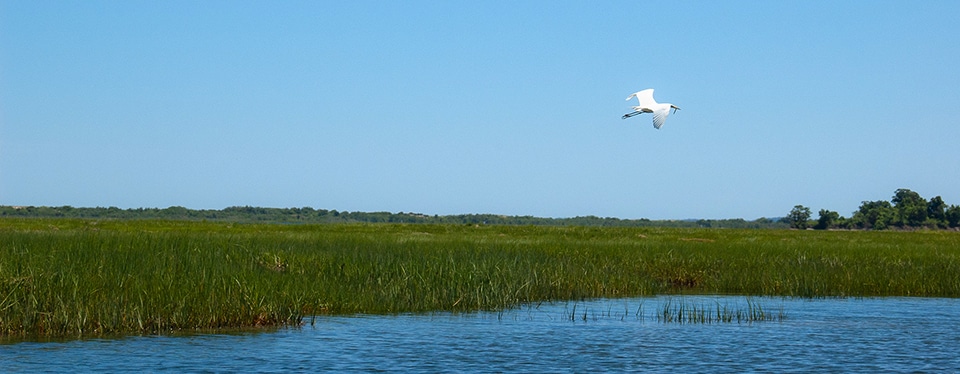
For example, Woodwell’s TIDE Project1 spent over two decades studying the Plum Island Estuary. The research shows that nutrient runoff from agriculture and development—even if it originates near seemingly “isolated” wetlands—eventually impacts the health of the entire estuary. By removing federal protections from wetlands that do not “touch” navigable water, the agencies are inviting a surge in nutrient pollution that will lead to eutrophication, algal blooms, and the eventual collapse of downstream aquatic ecosystems.
The Critical Role of Wetlands in Carbon Sequestration
The proposed rule fails to account for the immense value of wetlands as carbon sinks. Terrestrial and tidal wetlands sequester and store more carbon per unit area than almost any other ecosystem on Earth, including forests.
Woodwell’s research identifies wetlands as high-carbon ecosystems that provide immediate climate benefits. “Terrestrial wetlands (i.e. non-tidal freshwater wetlands) cover about 71 million hectares in the U.S. About half of this area is forested wetland and 23% is peatland, which contains very high carbon stocks (Kolka et al. 2018). Terrestrial wetlands are significant carbon sinks, sequestering about 55 million metric tons of carbon per year both above- and belowground.”2 Protecting these areas is a top priority for global carbon management because the carbon stored in wetland soils and biomass can be lost rapidly through drainage or surface hardening3—actions that become much more likely without federal CWA oversight.
Impacts on Climate Resilience and Risk Mitigation
The proposal argues that narrowing the definition will provide “regulatory certainty.” However, it creates profound environmental uncertainty by increasing the risk of catastrophic flooding and storm surges.
Wetlands absorb excess rainfall and buffer communities from the intensified flooding events caused by climate change. Woodwell scientists have documented how the loss of wetland capacity exacerbates flood risks for homes and businesses. The proposed “wet season” criteria for jurisdiction is particularly dangerous, as it ignores the fact that ephemeral and seasonal wetlands provide their most vital flood-attenuation services during extreme weather events—precisely when they may not meet the proposed “relatively permanent” test.
Coastal marshes are the first line of defense against rising sea levels. Woodwell’s research has shown that excess nitrogen (often filtered by upstream wetlands) causes marsh edges to collapse.4 By deregulating upstream “non-permanent” waters, the agencies will increase the nutrient load reaching the coast, weakening the very marshes that protect coastal infrastructure from storm surges.
Further, Woodwell is concerned by the proposal’s intent to limit the scope of “permafrost wetlands” through the “wet season” and “abutting” tests. The Arctic is warming three to four times faster than the rest of the planet. Permafrost wetlands are critical for stabilizing the soil and sequestering vast stores of carbon.
Conclusion
The proposed rule rejects scientific evidence and treats the landscape as a collection of disconnected parts rather than a single, integrated hydrological and biological system. Woodwell Climate Research Center urges the EPA and Army Corps to:
- Reevaluate “continuous surface connection” test in favor of a definition that recognizes subsurface and biological connectivity
- Incorporate the value of carbon sequestration and climate resilience into the Regulatory Impact Analysis
- Maintain protections for ephemeral and seasonal waters, which are essential for water quality and flood control in a changing climate
Again, failing to protect these waters will result in long-term economic and environmental costs that far outweigh any short-term “regulatory certainty.”