

Canceled government grant forces Chelsea, MA, to regroup
Woodwell Just Access report helps community seek new funding paths


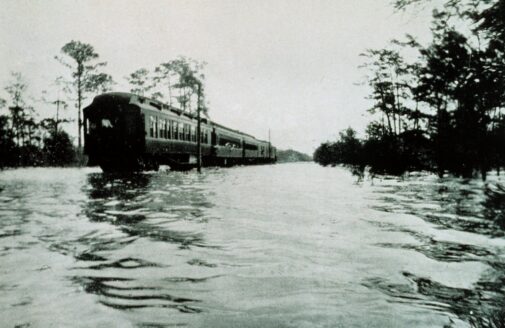
January 13, 2024: Three hours after high tide in Island End River Floodplain.
photo courtesy of the Town of Chelsea
Chelsea, MA, did everything right. The city had identified flooding as a major climate threat, sought out data on it, mobilized the community, and secured funding to design a solution. They were on their way to building climate resilience, until the change in federal administration forced them to regroup.
In April, 2025, the federal administration announced it was illegally canceling the Building Resilient Infrastructure and Communities (BRIC) program—a FEMA initiative that funded local infrastructure projects to protect communities from hazards like flooding and wildfire—on the grounds that it was “wasteful spending.”
The Island End River Flood Resilience Project was among the projects de-funded in the sweep. The project reenvisioned the shoreline of Chelsea and neighboring Everett, MA, with the construction of a flood barrier, tidal gates, and salt marsh restoration to protect both cities from extreme flooding.
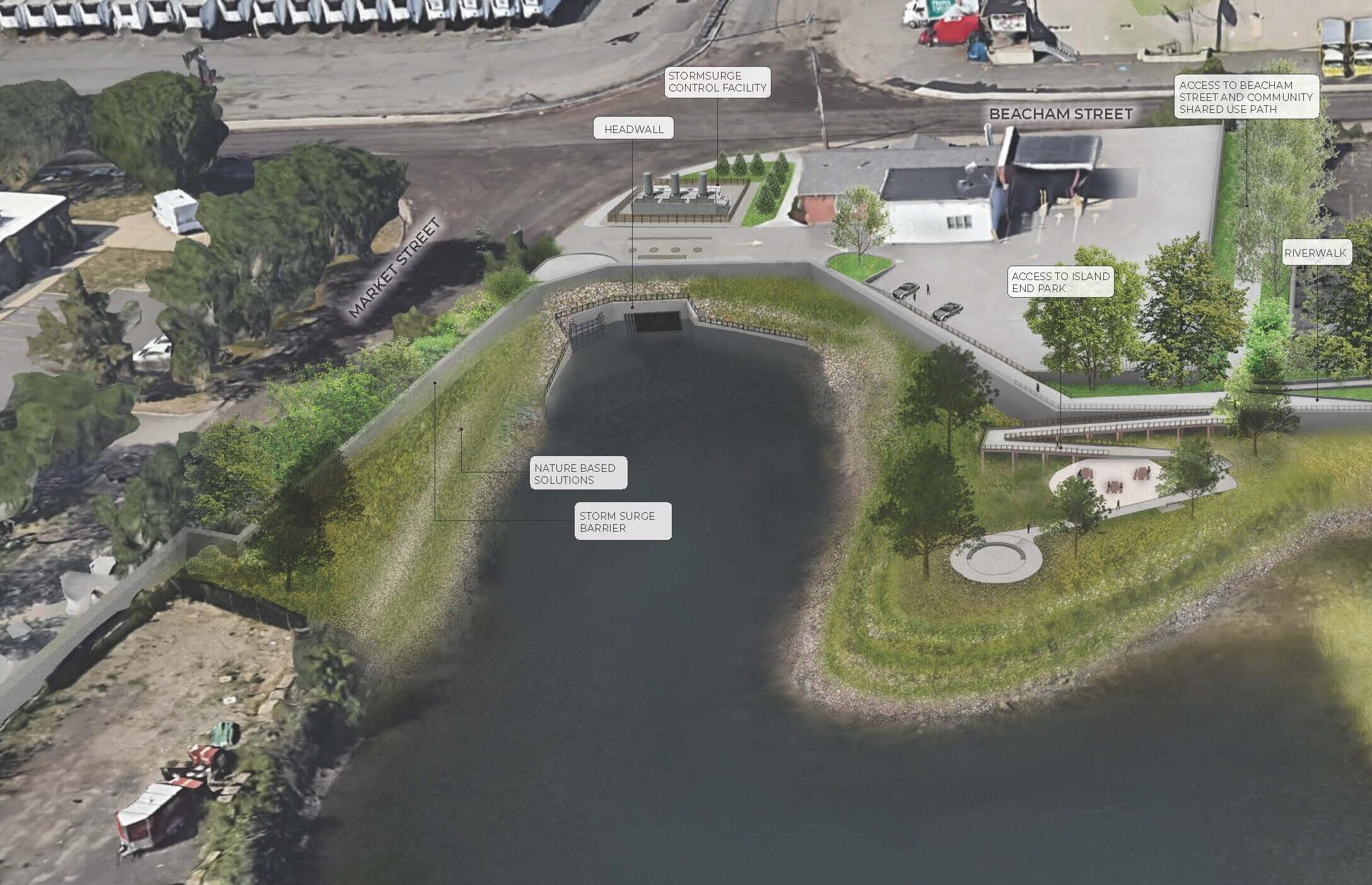
A rendering of shoreline improvements that would have been funded by the BRIC grant.
photo courtesy of the Town of Chelsea.
The cities are vulnerable to two forms of flooding—storm surge coming up from Boston Harbor and extreme rainfall events.
“This district is already flooding at least once a year to the extent that trucks can’t always pass down the road,” says Chelsea Housing and Community Development Deputy Director Emily Granoff.
Climate change will exacerbate this. According to a 2022 risk assessment conducted by Woodwell Climate’s Just Access program on behalf of the city and local non-profit GreenRoots, over 20% of the city will be at risk of flooding by 2050. Extreme high-intensity rainfall events could become three times as likely by mid-century and become an annual occurrence by 2080.
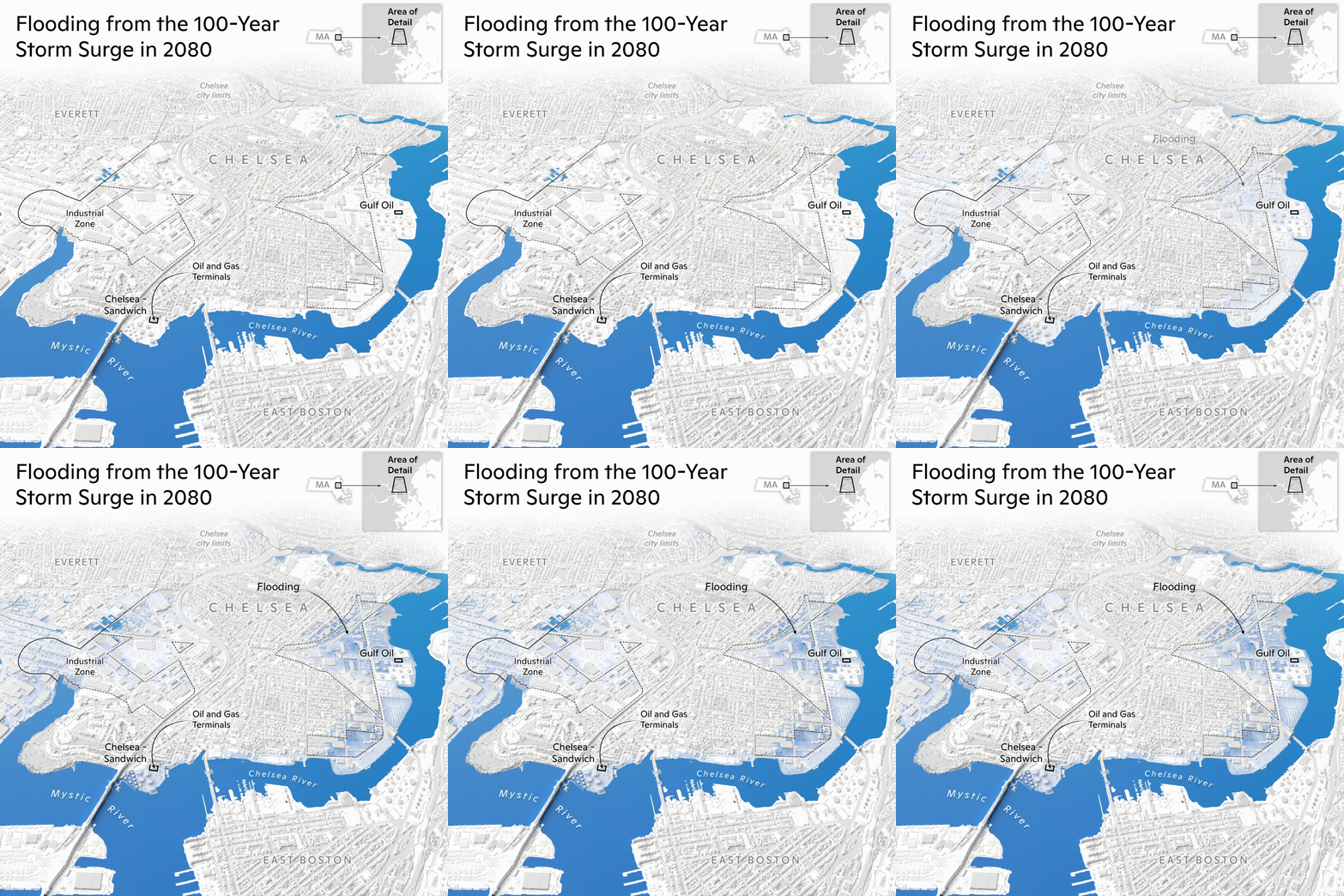
Model of estimated flooding by 2080 during a 1 in 100 year flooding event by 2080.
GIF by Carl Churchill
The irony of the cuts, Granoff says, is that this project was designed to save the cities of Chelsea and Everett millions of dollars. A cost-benefit analysis conducted for the project found that for every dollar spent on flood prevention, they would save more than $30 of repair and recovery spending in the wake of a major disaster. Several pieces of vital industrial infrastructure sit in the floodplain, including a busy commuter rail line, major truck corridors, and the New England Produce Center, which distributes fruit and vegetables to most northeastern U.S. grocery stores.
In addition to the $50 million BRIC grant, the project also lost a $20 million matching grant from the state, which was contingent on the federal funding. Without the project, the city will suffer $3.7 billion in direct damage, in addition to hundreds of millions of dollars in lost wages from employees who can’t get to work, lost sales from businesses forced to close, and health care costs from food insecurity.
“It’s important to realize how one federal program being cut like this can affect so many other things downstream,” says Eli Fenichel, director of communications and environmental policy in the office of Chelsea’s State Senator, Sal DiDomenico. “These projects are so important to protect businesses, communities, people, and save us—taxpayers, cities, states—so much money in future damage costs.”
The Island End River project was in the design phase when the BRIC grant was cancelled. After processing the loss, Granoff says project partners regrouped and identified two paths forward. The first would be completing the design and then putting it on the shelf, waiting for a more favorable funding environment. But that option comes with risks.
“The biggest risk is that we get unlucky,” says Nasser Brahim, director of climate resilience for the Mystic River Watershed Association, a partner on the project. “It’s just a matter of time before that area floods again. Every time there’s a nor’easter, every time there’s a king tide, we roll the dice. The odds are not in our favor in the long run.”
The second option would be to take a phased approach and seek out smaller chunks of funding for each stage. This strategy would still take longer to complete, but would allow the most critical flood mitigation measures to proceed—starting with a floodwall and culvert reconstruction. The later phases would bring in marsh restoration and more waterfront access.
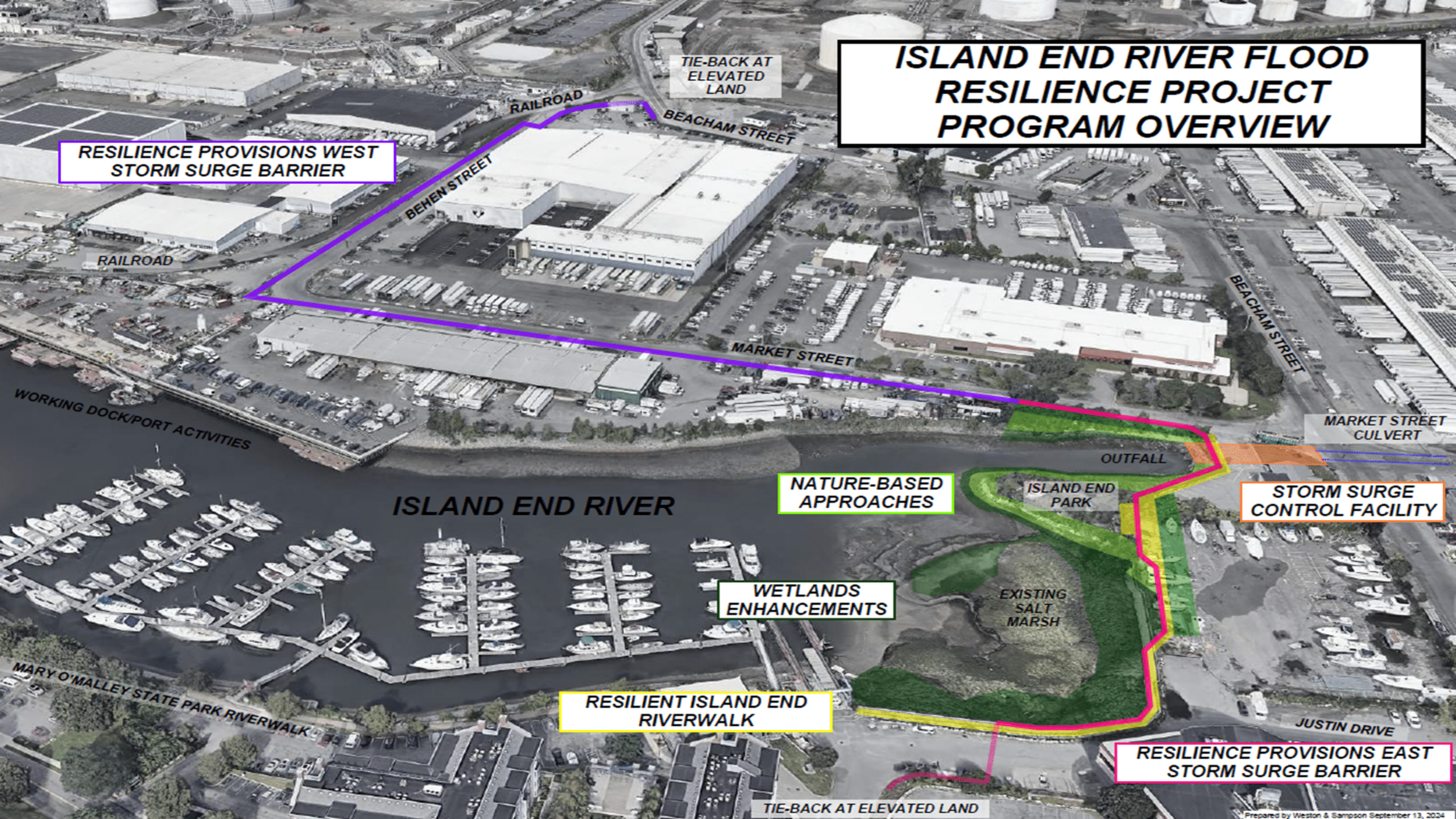
Island End Rover flood resilience project program overview. Colored sections could be completed in different phases.
image courtesy of the Town of Chelsea
The drawback to a phased approach is that pure infrastructure projects are less attractive to funders than nature restoration. Mystic River Watershed Association identified a possible opportunity to request funding for phase one from the Army Corps of Engineers, under the Water Resources Development Act, which is being re-authorized this year. According to Roseann Bongiovanni, executive director of the Chelsea-based community organization GreenRoots, the data in Woodwell’s Risk Assessment has helped the cities and their partners continue making the case for support for the Island End River project.
“The Woodwell report gave us the science-backed data that helped give weight to our advocacy around coastal resilience. We’ve noticed a change in the response of decision-makers since we were able to provide data about the risks,” says Bongiovanni.
Whether the project takes a phased approach or waits for full funding, the federal cuts represent a delay to a project that could save both lives and money.
“Every year we go without completing this project is another year where our people and critical infrastructure are at risk,” says Bongiovanni.