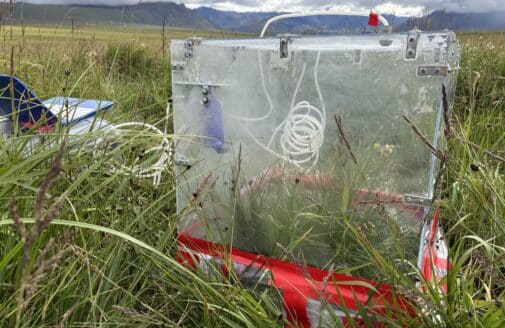


photo by Dave Hollinger
- Jennifer D. Watts Associate Scientist
- Kathleen Savage Senior Research Scientist
- Hinsby Cadillo-Quiroz Professor, School of Life Sciences, Arizona State University
- Jonathan Gewirtzman Yale University, Stanford University
- Shawn Fraver Associate Professor, Forest Ecology, University of Maine
PROJECT: BOREAL BIOSEQUESTER
Methane is a short-lived, but extremely potent greenhouse gas, trapping over 80 times more heat than carbon dioxide over a 20-year period. Reducing the amount of methane in the atmosphere is one of the fastest ways to slow near-term climate warming.
The Boreal Biosequester project is seeking a solution. Through our research at the Howland Research Forest, ME, we have identified a promising and severely understudied frontier: harnessing methane-consuming microbes that live on tree surfaces to reduce methane in the atmosphere.
Our Work
All of the surface area in forests—soil, tree bark, leaves—interface with the atmosphere. Yet this enormous living surface has barely been explored for its methane-removing potential, particularly the surfaces of trees.
At Howland Research Forest, our research has shown that drier upland soils absorb atmospheric methane while wetlands emit methane to the atmosphere. However, when looking at the landscape as a whole, this sub-boreal forest is a net sink of methane—meaning there is more methane being taken up than emitted to the atmosphere.
Our initial findings suggest that microbes living on trees may play a role in the forest being a methane sink, and that trees are as significant for methane consumption as dry upland soils. However, there are critical questions to answer:
- Who are these microbes and where do they live?
- How do they function?
- What conditions make them thrive?
- Can we optimize their conditions to boost their removal of methane?
The Boreal Biosequester project aims to answer these questions, with the overarching goal of removing methane from the atmosphere by harnessing the power of microbes living on trees. With microbes’ help, we may be able to offer an important mitigation tool that helps slow climate warming.
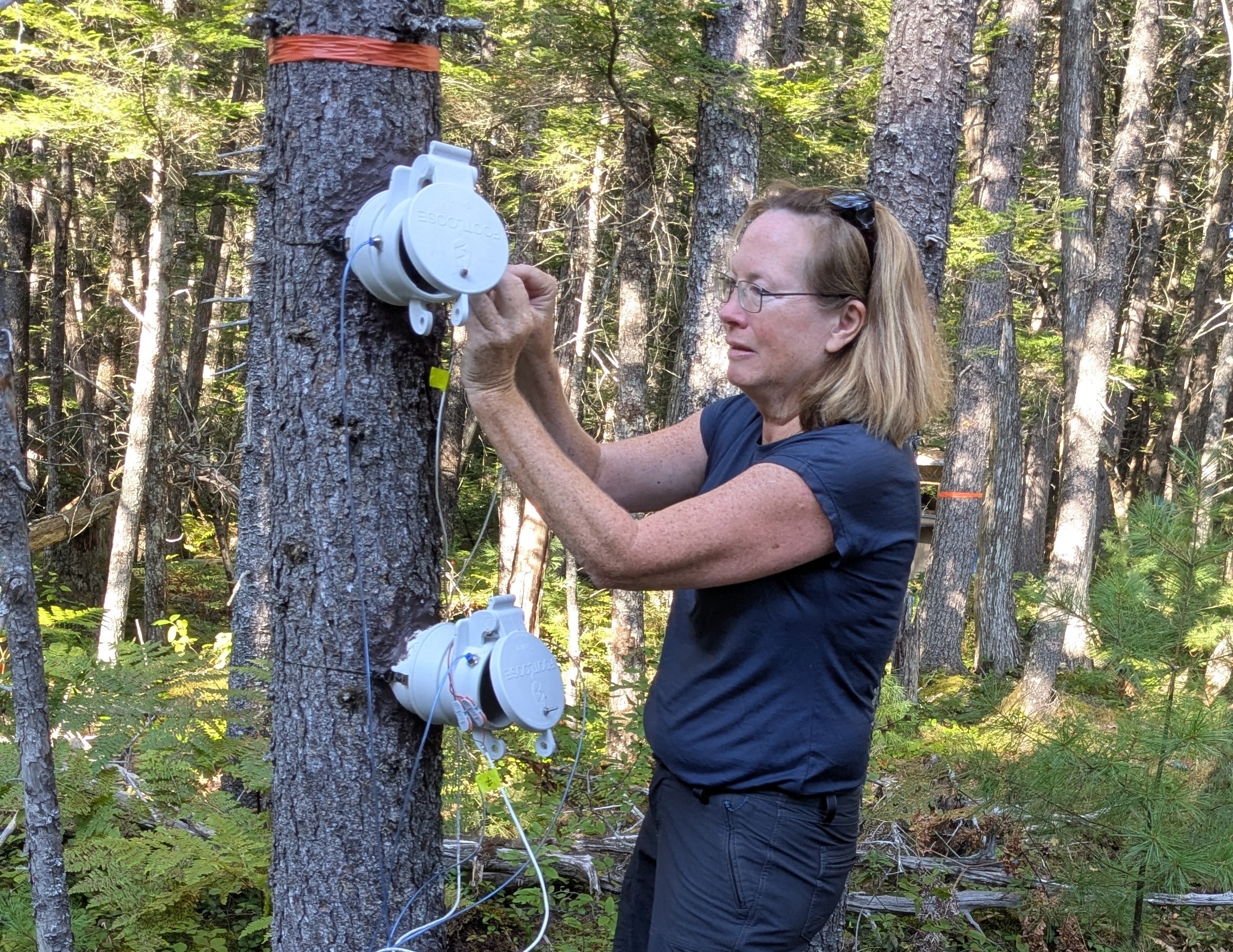
Kathleen Savage checking chambers that measure the flux of methane on tree trunks. Photo by Jennifer Watts
Our Impact
Removing methane from the atmosphere will have a significant impact on curbing future warming. Microbes are everywhere, offering a potentially scalable natural climate solution.
Using our findings, we will create a global toolkit for methane-smart forestry, providing data-driven guidance to governments, restoration initiatives, and carbon markets. This resource could help scale a major natural climate solution—potentially removing more than ~10 million metric tonnes of methane annually through targeted forest management. This emissions offset would be equivalent to taking more than 65 million passenger cars off the road for a year (based on the interactive U.S. EPA Greenhouse Gas Equivalencies Calculator).
By revealing the power of microbes as a natural climate solution, we can further incentivize protecting and restoring forests so that they, and the microbes that live within them, can help us meet our climate goals.
Partners & Collaborators